
Trying to choose between IGCSE and the International Baccalaureate (IB)? You are not alone. Both are popular qualifications used widely in international schools. However, they offer very different experiences, and so it helps to understand how they compare. This guide compares the IGCSE with the IB Diploma Program (DP), which some schools offer instead. We will also talk about the IB Middle Years Program (MYP) to show how the IB path continues after age 16. Moreover, the guide will explore how the two systems compare in terms of subjects, grading, assessment, and skills. Students will also find advice on which qualification might suit their learning style and what comes next, whichever path they choose.
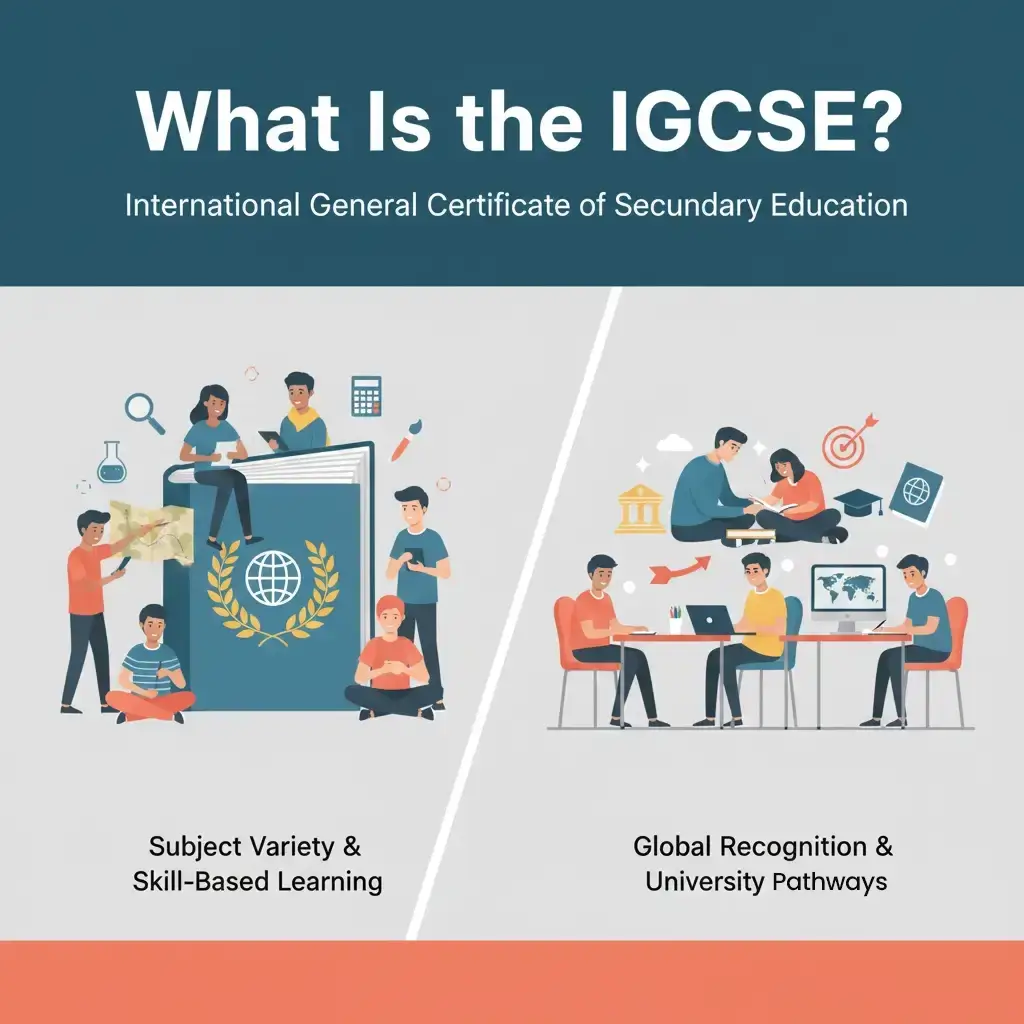
The IGCSE stands for the International General Certificate of Secondary Education. This qualification is internationally recognized for students aged 14 to 16 around the world. It is designed for a global audience and is closely based on the UK GCSE.
In this curriculum, students take around 8 to 10 IGCSE subjects, including core ones. These include English, Maths, and Science, and a combination of optional subjects such as History, Art, Computer Science, or Business.
The IGCSE offers a lot of flexibility, allowing you to choose a mix that aligns with your strengths or interests. Most IGCSE subjects are assessed through written exams at the end of the course. However, some include coursework or practical work, depending on the subject.
Grades are awarded on a scale of A* to G, or sometimes 9 to 1, depending on the exam board. A grade C or a 4 is considered a standard pass. The IGCSE is a strong academic foundation that prepares students for A Levels, the IB Diploma program, or other post-16 qualifications.
The IB (International Baccalaureate) is a global education system that is taught in schools around the world. This curriculum includes various programs for different age groups:
The IB MYP is an international alternative to IGCSE, and it is studied between the ages of 11 and 16. This program includes eight subject groups:
In your final year, you will also complete a Personal Project. This consists of a long-term research or creative task based on a topic of your choice. The MYP allows students to develop skills like research, collaboration, and critical thinking, instead of simply memorizing content for final exams. Some schools offer optional assessments, but many assess students through coursework, teacher feedback, and classroom projects.
The diploma program follows the MYP and is for students aged 16–18. It is similar to the stage when UK students take A Levels. You will study six subjects from different groups, such as:
Students will also complete three core components:
Assessment in the IB DP includes a mix of coursework, presentations, projects, and final exams. The IB focuses on developing students who are independent thinkers, internationally minded, and ready for the demands of university or their upcoming career.
Now you know what each of these qualifications involves, below is the side-by-side comparison of the differences between them.
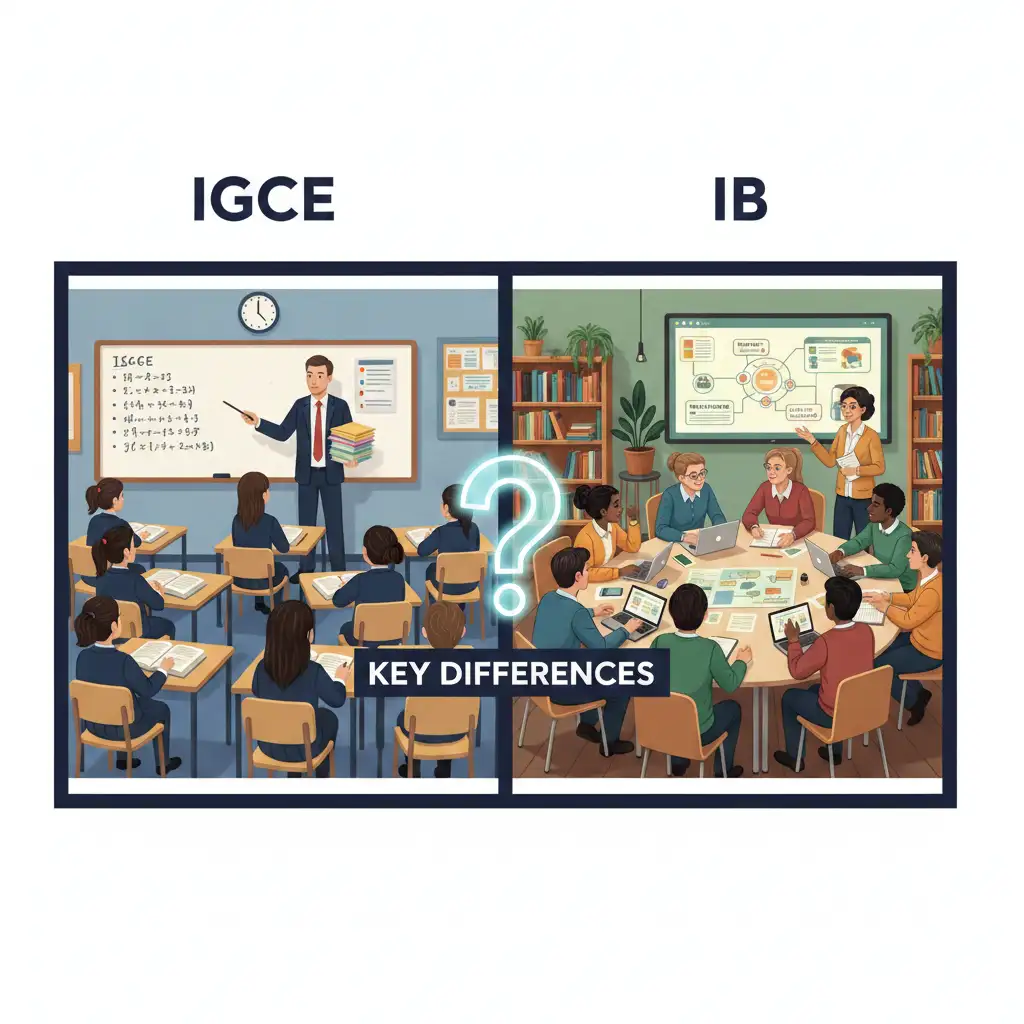
IGCSE is taken between the ages of 14 and 16, and it lasts for two years. It is the final qualification before students move on to post-16 study, such as A Levels or the IB Diploma.
However, IB MYP is designed for students who are aged between 11 to 16, covering a broader age range than IGCSE. In some international schools, the MYP replaces IGCSEs altogether, especially in Years 10 and 11. The IB diploma program is a post-16 qualification for students ages 16–18, taken after completing IGCSEs, MYP, or similar courses.
Students in IGCSE choose around 8 to 10 subjects. Some subjects are compulsory, like English, Maths, and Science. However, there is flexibility to choose other optional subjects based on your goals or strengths. The wide range of IGCSE subjects allows you to build a customized program.
The IB mid-year program includes eight subject groups that students learn across the whole program. These include languages, sciences, arts, humanities, maths, and physical education. There is less flexibility in IB, but the curriculum is comprehensive and integrated.
The IB diploma program requires students to study six subjects. They have to choose one subject from each group. You have to choose three subjects at Higher Level (HL) and three at Standard Level (SL). In addition, all students complete Theory of Knowledge (TOK), the Extended Essay (EE), and Creativity, Activity, Service (CAS).
IGCSE grades are given per subject and follow the 9–1 scale or the A–G* scale, depending on the exam board. In this curriculum, assessment is exam-based, with some subjects including a coursework element or practical assessment components.
The IB mid-year program follows a 1–8 scale for each subject and depends on internal assessments, classroom work, and teacher evaluations.
The IB diploma program is scaled from 1 to 7 for each subject, with three extra points available for the core components, making a maximum score of 45. The assessment includes a combination of coursework, internal assessments, and final exams.
IGCSE focuses on content knowledge and exam skills. In this curriculum, students spend time learning key facts, practicing exam technique, and building subject knowledge.
The IB mid-year program develops inquiry, research, and reflection. Students explore big ideas across subjects, make cross-topic connections, and complete a personal project to highlight their independent learning.
However, the IB diploma program focuses on critical thinking, essay writing, research, and academic independence. It is designed to prepare students for university-style study.
IGCSE is respected internationally and is followed by developments to A Levels or other national qualifications. The IB mid-year program is not always externally examined. However, the IB schools set the groundwork for success.
The IB diploma program is also a globally accepted qualification and is recognized by top universities. It allows you to develop strong skills, become independent learners, and prepare for university-style study.
IGCSE and IB have their own strengths and challenges. Below is the detailed comparison to help you think about which might suit you best.
Feature | IGCSE | IB |
Subject Choice | More freedom to choose subjects you like or want to study for your plans. | A comprehensive curriculum, giving fewer opportunities to drop entire subject areas. |
Assessment Style | Mostly final exams, with some coursework depending on the subject. | A combination of coursework, internal assessment, and final exams. |
Workload | Builds toward final exams over two years. | Steady, challenging workload across the whole course. |
Skills Focus | Focuses on subject knowledge and exam technique. | Focuses on research, critical thinking, and global awareness. |
Learning Style | More structured | Inquiry-based, boosts independent learning and reflection. |
Recognition | Accepted in the UK and many other countries. | Highly respected by universities worldwide, especially for global study. |
Best for | Students who have clear goals, specialize early, and perform well in exams. | Students who enjoy variation, discussion, project work, and longer-term study. |
There is no one-size-fits-all answer when it comes to choosing between IGCSE and IB. Both are highly recognized and respected qualifications that can help you for success. However, they suit different types of students. Below is the checklist to help you learn which one matches your learning style and goals.
The IGCSE and IB are not competitors; they are simply different options within the same education journey. Many students take IGCSEs first and then move on to study the IB Diploma later. The right direction depends on your learning style, academic goals, and upcoming plans. Understand how you want to learn, where you want to study next, and which exam structure feels easier. Ask your school teachers and advisors to help you with your decision. Remember, both IGCSE and IB will help you to develop valuable skills and can open doors to exciting academic and career opportunities.
Mixt Academy offers a wide range of resources for both qualifications, so take a look at the IGCSE learning materials or the IB resources. There are revision notes, worked examples, and past papers to help you picture what you will be studying in the courses you choose.
Yes, you can take IB after IGCSE, and many students do the same. The IB Diploma program is designed for students ages 16–18, so it naturally follows after IGCSEs. Moreover, IGCSEs prepare students for the IB due to the development of strong academic foundations in subjects like English, Maths, and Science.
The IB is not harder, just a different type of challenge from IGCSE. The IB MYP focuses on enquiry, projects, and skill-building. In contrast, IGCSE is more exam-based and content-heavy. Students with the IB mid-year program work more independently and are assessed throughout the course, not just in final exams. Some find this more challenging; others prefer it to exam pressure.
Both IGCSE and IB are respected and better for university. However, it depends on where you are applying and what you want to study. For UK universities, A Levels following IGCSEs are the most common path. But the IB is equally accepted and gives students an advantage when applying to competitive universities, especially abroad. But keep in mind, universities will consider your grades, subject choices, and your personal statement or application.
Yes, but the timing matters. Switching from the IB mid-year program to IGCSE, or from IGCSE to the mid-year program, is possible, especially if you are changing schools or moving internationally. However, the transition can be challenging, especially in Year 10 or 11, due to curriculum differences. Because the two systems don’t always align perfectly in terms of content or style, you might need support to bridge any gaps.

Mixt Academy is a global online tutoring platform that connects students with expert IGCSE, GCSE, and A-Level tutors for one-to-one learning. With flexible scheduling, personalized lesson plans, and experienced teachers from top curricula, Mixt Academy helps students strengthen concepts, improve exam skills, and achieve higher grades with confidence.
IGCSE Physics Formula Sheet: Key Formulas for 0625 & Edexcel…
IGCSE Chemistry Papers: Common Mistakes & Exam Tips This IGCSE…
IGCSE Extended vs Core Tiers: How to Pick the Right…
Understanding GCSE Grade Boundaries and How to Prepare? Grade boundaries…
Differences GCSE English Language vs English Literature GCSE English is…
What is GCSE? A Guide for International Students & Parents…
A Level vs AP: Complete Guide to Choosing the Right…
Top Benefits of Completing AS and A Levels Privately Explore…
Cambridge vs IB Guide to Choosing the Best Curriculum Choosing…
IB vs A Levels: Which Qualification Is Right for You?…
How to Use OCR Past Papers for Effective Revision? Past…
AQA Physics Equation Sheet: Complete GCSE Guide for Combined Science…
AQA vs Edexcel Complete GCSE Comparison and Guide Choosing between…
Complete Guide to the AQA GCSE Chemistry Specification Understanding the…
Hire an Expert Tutor from Just 15$/hr