
Are you confused about the difference between IGCSE Core and Extended tier papers? You are not alone. Many students worry about whether they are in the right tier, especially when it comes to choosing subjects, getting the best possible grade, or planning for A Levels/IB and university admissions. This guide breaks down the key differences between Core and Extended IGCSE tier papers, along with their subject-specific examples. It also explains how these tiers affect IGCSE grading, factors to consider to pick the right tier and the importance of selecting the suitable one, so you can make the choice about which is best for you.
IGCSE offers two levels of exams for many subjects. These include Core and Extended tiers, and both follow the same overall syllabus. However, the depth and difficulty of the content differ. Check the IGCSE website to see which subjects tiered papers are offered in.
The Core tier covers the foundational ideas and is designed for students targeting grades C to G or 4-1. This paper includes a higher number of less challenging questions designed for students who find this subject more difficult. This tier is ideal if you want steady progress and a solid foundational knowledge of your subject.
The content focuses on fundamental concepts and skills, providing a broad understanding without focusing on the more complex and challenging aspects. Assessment methods in the Core syllabus typically focus on recall and application of basic knowledge.
The Extended tier includes everything in the Core tier plus additional, more challenging material, and is aimed at students working towards grades A* to E or 9-2. This more advanced paper, which includes a higher number of moderately and very challenging questions, is designed for students who find this subject less complicated overall. This tier is best suited for students who are planning to study the subject at A Level or beyond.
Extended assessments require higher-order thinking skills, such as analysis, evaluation, and problem-solving. This syllabus prepares students for advanced studies like A-Levels and university, providing them with a comprehensive understanding of the subject matter.
Cambridge (CIE) IGCSE offers two levels of exams for many subjects: Core and Extended. Both follow the same overall syllabus, but the depth and difficulty of the content differ.

Tier | Core | Extended |
Course Content | Basic concepts, definitions, and foundational skills. | Everything covered in Core, plus more in-depth and advanced content. |
Exam Questions | High number of less challenging questions. Some moderately challenging questions are included. | Higher number of moderate to very challenging questions. |
Difficulty Level | Less challenging; questions focus on basic knowledge. | More challenging questions require higher-order thinking. |
Grading | C to G or 4-1 | A* to E or 9-2 |
Suitability | Suitable for students who want to build confidence in their subject, learn foundational skills or need extra support. | Better for students aiming for top grades, who want to be challenged in this subject or are planning on taking this subject at A Level or beyond. |
Preparation for Further Studies | Provides a foundation but may not fully prepare students for the demands of A-Levels. | Provides a more comprehensive preparation for A-Levels and university. |
The overlap of three grades (C, D and E) is designed to accommodate students who perform either better or worse than their teachers expect. Students who fail to meet the minimum satisfactory standard for either the Core curriculum (Grade G) or the Extended curriculum (Grade E) will be ungraded.
In some subjects, the exam covers the complete ability range, and there is no choice of Core and Extended papers. For these subjects, the full range of grades is available.
It is important to remember that Core covers grades C to G and Extended covers grades A* to E. If a student is securely in the ‘middle’ of the range, only the Extended tier will offer the grades the student may be capable of achieving. Students are not able to achieve above a C for their syllabus grade if they are entered for the Core curriculum.
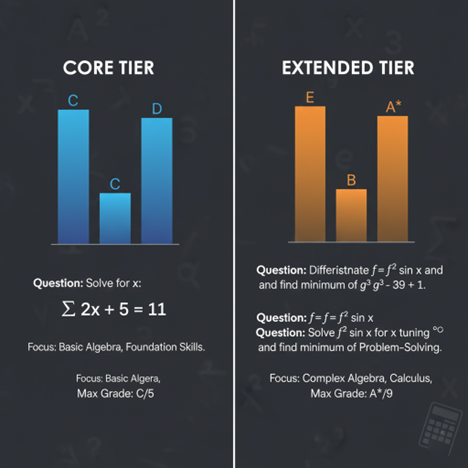
Here are the differences between the IGCSE core and extender tiers based on the specific subject examples to make a clear picture for the confused students.
Core Maths focuses on basic number work, algebra, geometry, and data handling. It is ideal for students who are just starting to develop confidence with mathematical thinking and generally find this topic quite difficult.
Extended Maths includes all Core topics plus more complex algebra, trigonometry, and problem-solving. It is aimed at students who find this subject moderately challenging or easy, as well as those who want to continue the subject at A Level or beyond.
Core Science covers fundamental ideas, definitions, and straightforward applications. It is a solid option if you want to build your understanding of key scientific principles. If you are finding science challenging, you may also perform better in this tier.
Extended Science includes all Core content plus detailed theoretical knowledge, experimental data, and application questions. This is ideal for students who enjoy learning a wide range of scientific ideas and find this topic moderately challenging or easy. Students interested in studying a science-related A Level or university course, or choosing a STEM career, may also wish to take this tier.
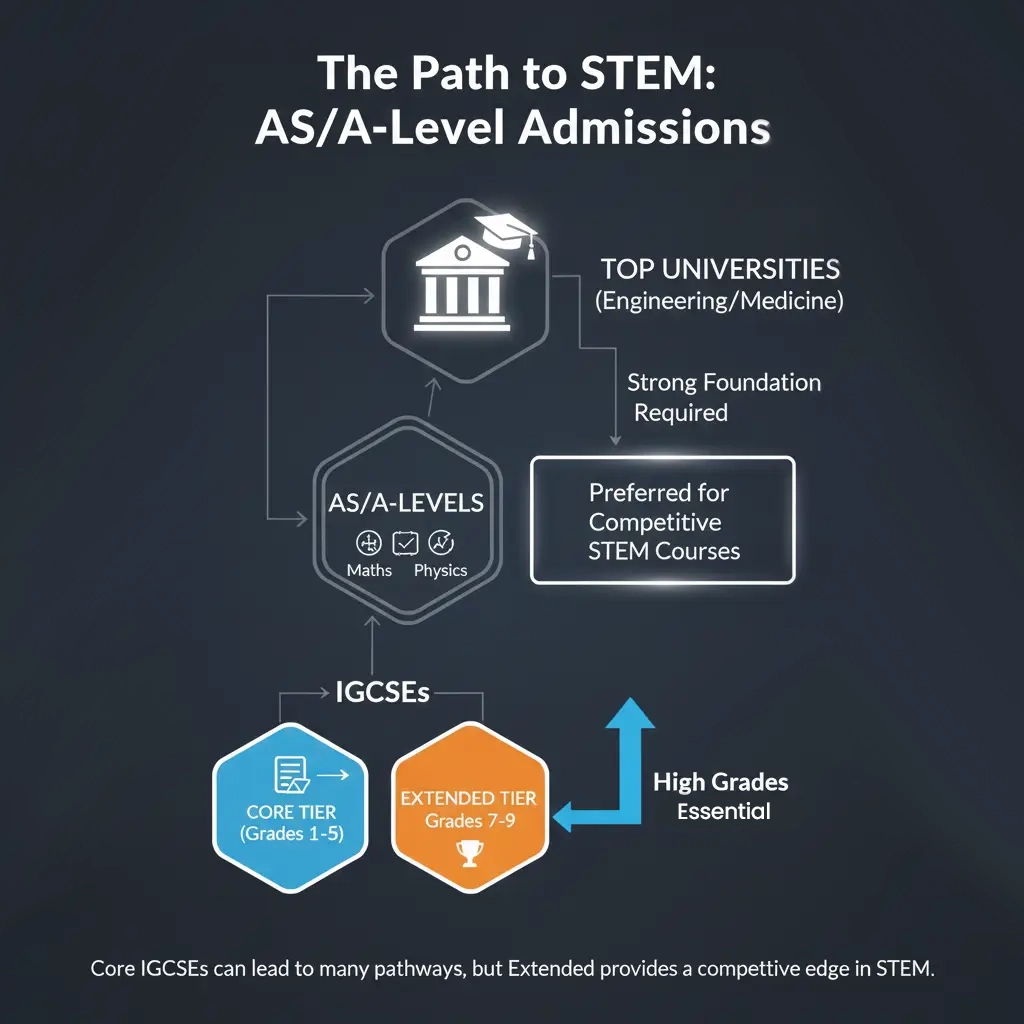
AS/A-Level programs consider IGCSE grades, particularly in subjects relevant to the chosen A-Level courses. Choosing the Extended syllabus can demonstrate a student’s academic capabilities, ambition, and willingness to tackle challenging material, giving them a competitive edge in the admissions process.
While a Core IGCSE grade can be sufficient for AS/A-Level entry, Extended qualifications often provide a unique advantage. For example, students applying for A-Level Physics or Mathematics are generally expected to have achieved a high grade in Extended IGCSE Physics or Mathematics. A strong performance in Extended IGCSE showcases a student’s aptitude and builds a solid foundation for success at the more advanced level.
It is essential to address the misconception that Core is a ‘lesser’ option. It is not. Core can absolutely lead to successful academic pathways. However, for highly competitive AS/A-Level programs, particularly in Science, Technology, Engineering, and Mathematics fields, Extended IGCSEs are considered more favourable.
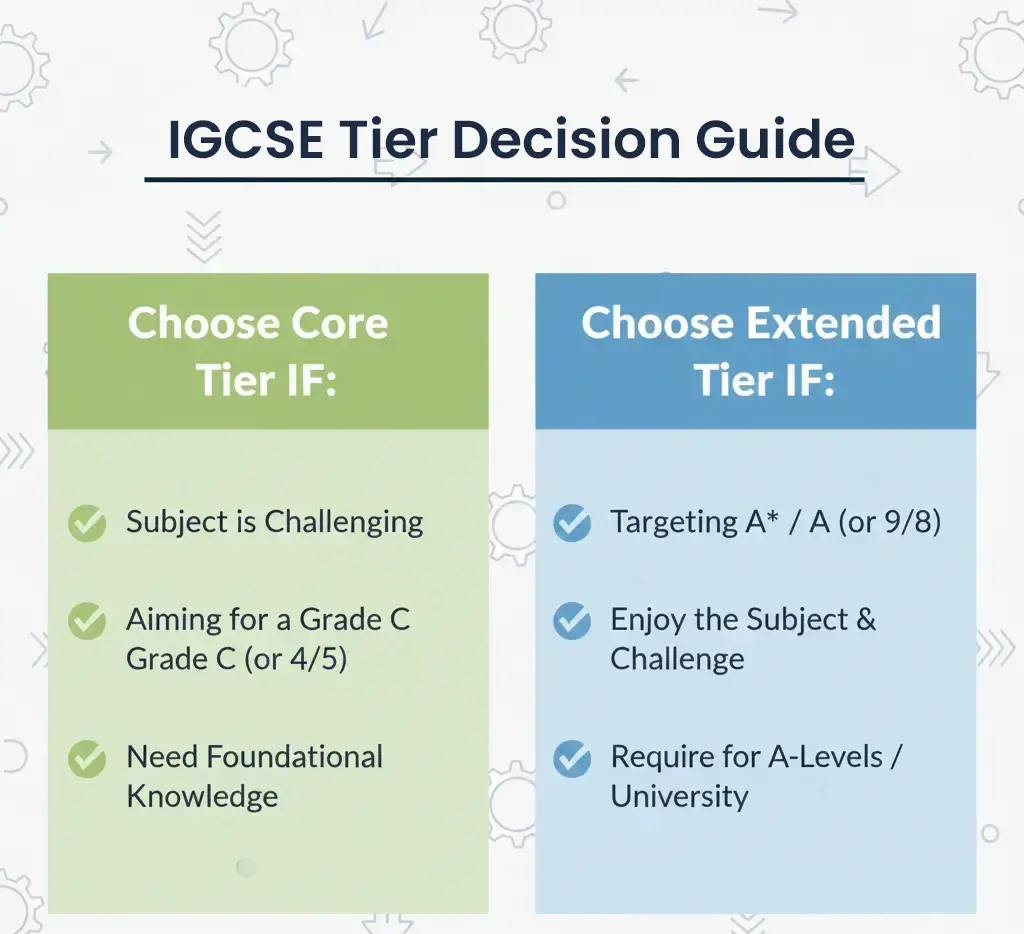
The decision between Core and Extended should be based on a careful assessment of your child’s individual needs and circumstances:
Students must check their strength and how much they are ready to face the challenges. An extended curriculum demands a deep commitment to study and a good command of time management. Reflect on your study habits.
If you are excellent in a particular subject and want to make it your career, you should go for an extended curriculum. You can also seek guidance from your school teachers and academic advisors from Mixt Academy, who can help you make the right decisions.
If you plan to study A-Level at a famous university, you should choose an extended curriculum because it will provide you with a stronger foundation for getting admission to A-Level.
If you have great aspirations for your career, for example, if you want to pursue the career of an engineer, you need a strong background in mathematics and physics, so you should go for an extended curriculum.
IGCSE extended course demands a heavy workload of multiple subjects, which might increase your stress level.
Sometimes, balancing academic workload and personal well-being can be challenging. It would help if you chose the level according to your caliber.
You should be aware of different grading scales. The core curriculum has a grading system from P to G, while the extended curriculum grades from A to E. It would help if you chose an extended curriculum to get the highest grade in a particular subject.
Students are well aware of their strengths and weaknesses. If you want to achieve the highest grade in a particular subject, you prefer an extended curriculum.
The extended curriculum requires comprehensive resources, so you should have sufficient study material and resources if you choose an extended curriculum.
There should be a sound support system to guide you throughout the journey of the extended IGCSE curriculum. You should arrange good tutors and study groups where you can get appropriate information and guidance.
Below are the common misconceptions that exist among the students and the facts to answer them effectively.
Myth: “Core means you have failed”
Fact: Core is designed for a specific grade range, and many students succeed through it.
Myth: “You cannot do A Levels if you take Core”
Fact: It depends. Some A Level courses or schools require a B or 6 and higher, which may mean taking the Extended tier is the best option.
Myth: “Extended is always better”
Fact: Not always. What matters most is choosing the tier where you can succeed and feel confident.

Struggling to decide between the IGCSE Core and Extended tiers? Mixt Academy offers expert online IGCSE tutoring designed to help you succeed, no matter which tier you choose. Our certified IGCSE tutors for core and extended levels provide personalized lessons, focusing on your strengths, addressing your weaknesses, and guiding you through exam strategies for top grades. What you will gain:
Take control of your IGCSE journey with Mixt Academy’s one-on-one tutoring and get the guidance you need to perform at your best. Book a free trial now and start mastering your Core or Extended subjects with confidence.
Choosing between the IGCSE Core and Extended syllabuses is a significant decision. Remember that the key difference lies in the depth of content covered and the level of challenge presented. The most crucial factor is to consider your child’s individual strengths, learning style, and future academic aspirations.
Overall, Core is a good fit if you need more support or want to focus on foundational understanding. While Extended better suits students aiming for higher grades or planning to study the subject at A Level and beyond.
Speak to your teachers and think about your next steps before deciding. Success in Core can be more valuable than a low grade in Extended, so pick the option that helps you feel confident and perform at your best.
Sometimes, this depends on your school and how early in the course you make the decision. Ask your teacher/school as soon as possible.
Some universities may accept it, but competitive courses usually prefer Extended with higher grades. Always check the entry requirements.
No, the topics are the same, but the Extended tiers require a deeper understanding and some additional content. Some questions in the Extended exams are also more challenging and require more advanced knowledge and skills.
Extended is often preferred for A Level entry, especially in subjects like Maths or Science. But it depends on where you are studying and your overall performance and confidence in the subject. If you are unsure, check with the school/college where you are planning to take your A Levels.
Yes, you can mix and match tiers depending on your strengths in each subject.
Yes, both the core and extended syllabuses are recognised globally. However, universities and colleges may have specific entry requirements, so it is essential to check their preferences.
While the extended syllabus may provide a deeper knowledge base, both options can lead to various career paths.
Yes, many students choose to take a mix of core and extended subjects based on their strengths and interests.

Mixt Academy is a global online tutoring platform that connects students with expert IGCSE, GCSE, and A-Level tutors for one-to-one learning. With flexible scheduling, personalized lesson plans, and experienced teachers from top curricula, Mixt Academy helps students strengthen concepts, improve exam skills, and achieve higher grades with confidence.

IGCSE Physics Formula Sheet: Key Formulas for 0625 & Edexcel…
IGCSE Chemistry Papers: Common Mistakes & Exam Tips This IGCSE…
IGCSE Extended vs Core Tiers: How to Pick the Right…
Understanding GCSE Grade Boundaries and How to Prepare? Grade boundaries…
Differences GCSE English Language vs English Literature GCSE English is…
What is GCSE? A Guide for International Students & Parents…
A Level vs AP: Complete Guide to Choosing the Right…
Top Benefits of Completing AS and A Levels Privately Explore…
Cambridge vs IB Guide to Choosing the Best Curriculum Choosing…
IB vs A Levels: Which Qualification Is Right for You?…
How to Use OCR Past Papers for Effective Revision? Past…
AQA Physics Equation Sheet: Complete GCSE Guide for Combined Science…
AQA vs Edexcel Complete GCSE Comparison and Guide Choosing between…
Complete Guide to the AQA GCSE Chemistry Specification Understanding the…
Hire an Expert Tutor from Just 15$/hr