Overview of IGCSE Chemistry
IGCSE Chemistry helps students to understand the amazing world around them at an atomic level. The subject is part of the internationally recognised IGCSE combined science tutoring journey. It is offered to students around the world between the ages of 14 to 16.
In this science-based subject, students will learn how atoms bond together, why chemical reactions happen, and what makes different substances behave the way they do. The course content of IGCSE Chemistry tutoring focuses on four core concepts:
- The study of matter
- Chemical reactions
- Energy changes
- Atomic theory
You can study Chemistry through two main exam boards offered by IGCSE tutors. These boards are Cambridge International Education (CIE) and Pearson Edexcel. Both are globally recognised, so whichever you take, you are working towards a qualification that opens new opportunities worldwide.
What Topics Will You Learn in IGCSE Chemistry?
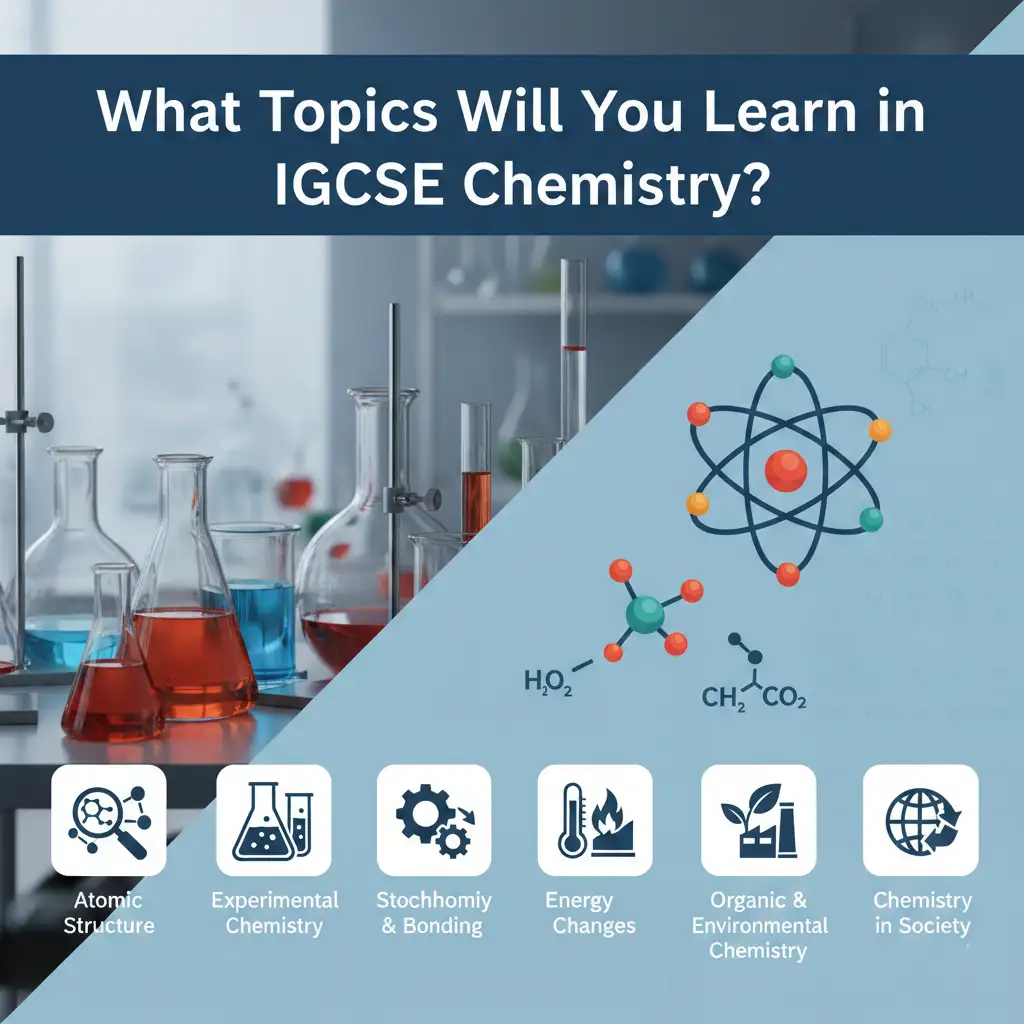
Here are what topics you will be exploring over the course of your IGCSE Chemistry journey.
- Atomic structure and the Periodic Table: You will start with the building blocks of everything, like atoms. Students will learn how they are structured and why the periodic table is arranged the way it is.
- Chemical bonding and properties of substances: Ever think why water is liquid, but carbon dioxide is a gas? You will discover how atoms stick together and how this affects what substances can do.
- Acids, bases, and salts: From the lemon juice in your grocery to the antacid tablets in your medicine, you will explore how these crucial chemicals work in everyday life.
- The Mole concept and stoichiometry: This is where maths meets chemistry. You will learn to calculate exactly how much of each substance you need for reactions, like following a very precise recipe.
- Rates of reaction and equilibria: Why do some reactions happen instantly, while others take ages? You will find out what speeds things up or slows them down.
- Organic chemistry: This course is also named as chemistry of life. You will study carbon-based compounds that make up everything from plastics to the food you eat.
- Chemical energetics and electrolysis: Discover why some reactions release energy whilst others absorb it, plus how electricity can drive chemical changes.
- Environmental Chemistry and pollution: Learn about the chemistry behind environmental issues and how science helps us tackle climate change.
All these topics are interconnected by the concepts of each other. So, understanding the basics and fundamental knowledge will help you with the more complex ideas.
Exam Structure of the IGCSE Chemistry
Knowing and understanding the exam structure allows you to plan your revision more effectively and helps you focus on the right skills for each paper.
Paper 1: Multiple Choice Questions
The duration of Paper 1 lasts 45 minutes and includes 40 multiple-choice questions (MCQs). It is based on the Core syllabus and designed for students following the Core curriculum.
Paper 2: Multiple Choice
The time frame of this paper is also 45 minutes long. Paper 2 includes 40 questions covering both Core and Supplement content. It is suitable for students who are taking the Extended curriculum and aiming for grade C or above.
Paper 4: Theory Paper
The duration of this paper is 1 hour and 15 minutes. It features structured and short-answer questions that test knowledge across the whole syllabus and is designed for Extended level students.
Paper 5: Practical Test
Paper 5 takes 1 hour and 15 minutes and involves hands-on laboratory tasks. It assesses practical skills and scientific observation. However, not all schools offer this option.
Paper 6: Alternative to Practical (ATP)
The duration of this paper is 1 hour; this written paper tests your understanding of experiments and lab techniques. It is ideal for students who cannot take the Practical Test.
Common Mistakes Students Make in the IGCSE Chemistry Exam
Here are the most common mistakes that students make in the IGCSE Chemistry exam preparation in Dubai, which ultimately result in lost marks.
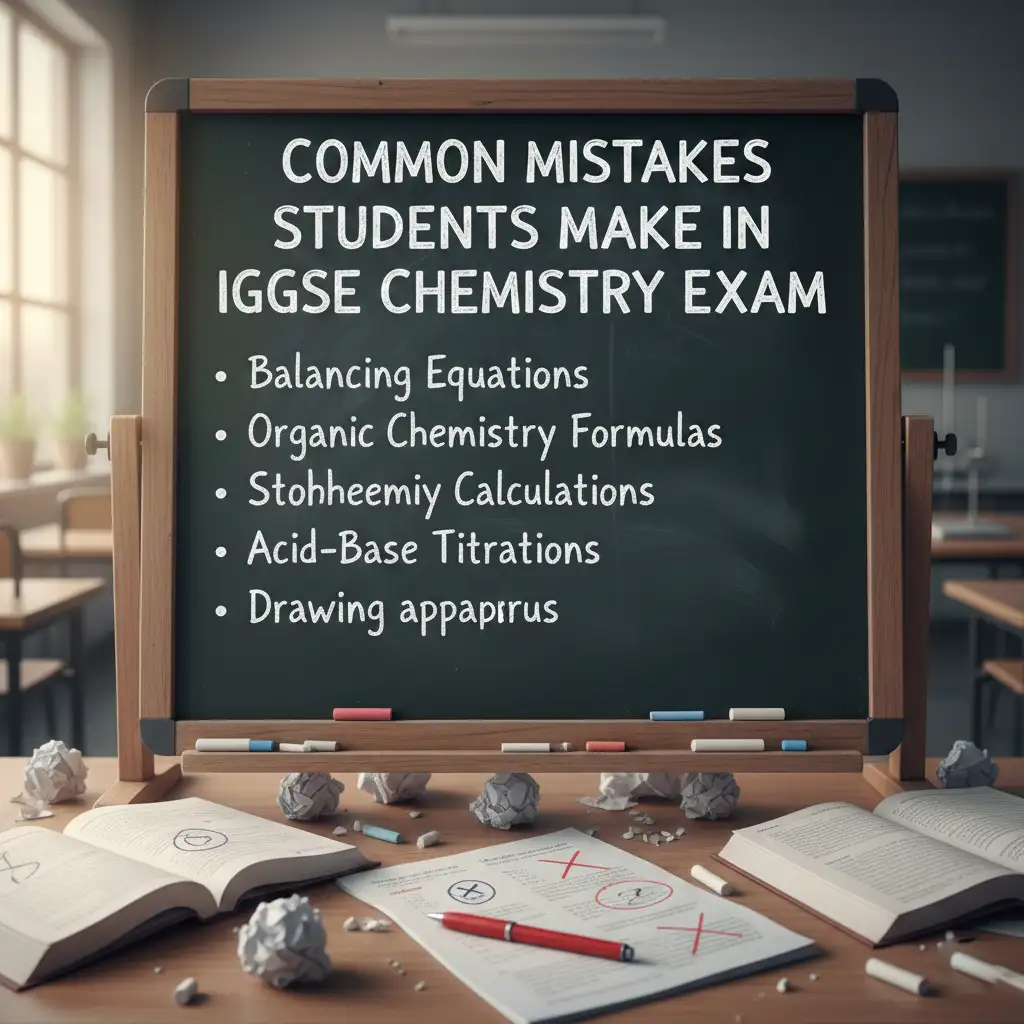
Misreading the Questions
In the IGCSE Chemistry paper, many students skip keywords and command words that change the meaning of the question. Moreover, they fail to notice the specific conditions such as temperature, pressure, catalyst, aqueous or molten, and concentration. Assuming the answer instead of understanding what is actually asked and forgetting to read diagrams, labels, and units attached to data are also examples of such mistakes.
Writing Answers in Long Paragraphs
Most students write answers in long paragraphs that hide keywords, mixing explanations and definitions in one chunk. In addition, they add unnecessary information and use unclear sentences that examiners cannot award marks for, costing them low marks.
Incorrect Use of Command Words
Writing explanations for state questions and giving descriptions instead of mechanism-based explanations are also common mistakes that students make in the IGCSE Chemistry past paper. Furthermore, predicting answers without using proper patterns and mixing up the command words like ‘compare’,’ contrast’, and ‘describe’ are also added to these mistakes.
Wrong Calculations of Units
Forgetting to convert cm3 to dm3 and using 24 instead of 24,000 or vice versa. Also, some students forget units entirely and confuse between g/dm3 and mol/dm3, with wrong significant figures being mistakes that cost marks.
Not Showing Clear Working
Many students write their final answer without a proper structure and steps. For example, not showing how moles were calculated and mixing numbers and explanations are included.
Incorrect Definitions
Missing keywords like ‘simplest’ in empirical formula, ‘proton donors’ in acids, ‘gain of electrons’ in reduction, and mixing up similar definitions. Moreover, writing confusing lines like ‘it is when something reacts’ are examples of such mistakes that must be avoided in IGCSE Chemistry exams.
Not Following the Formula
During the exams, one of the most significant errors is skipping the essential steps between the cause and effect during the explanation of a chemical reaction. Some students also repeat the question instead of answering it and write random formulas without a precise mechanism, which costs them marks.
Wrong Symbols for State
Using the wrong state symbol or forgetting them completely during an explanation is the biggest error. For example, writing (I) instead of (aq), (g) for dissolved gases, and (s) for dissolved solids.
Incorrect Chemical Equations
Most students use incorrect or unbalanced chemical equations without identifying the ions clearly. Moreover, wrong formulas like NAOH instead of NaOH, ignoring the atomic and charge balance, are the biggest errors that a student can make in IGCSE Chemistry exams.
Weak Practical Improvements
Writing confusing or missing wrong improvements and suggesting impossible steps in a practical question are the common mistakes that many students make. In addition, missing the limitations of the experiment and repeating the improvement process are examples of frequent errors.
How to Study Effectively for IGCSE Chemistry Exams?
Effective IGCSE Chemistry study comes from a clear plan, consistent practice, and active learning techniques.
Make Weekly Goals
Break the IGCSE Chemistry syllabus into weekly topics. For example, atomic structure, bonding, acids and bases. Choose a learning speed that suits you and stay consistent for better results.
Set Time for Regular Review
Regular review helps you remember what you have studied during your learning phase. Spend at least 30 minutes each week revisiting past topics using flashcards, summaries, or quizzes. Use a planner or app to stay organised and track your learning progress.
Use Active Learning Techniques
Just reading and memorizing alone is not enough to do better in the IGCSE Chemistry exams. Students must engage in active learning techniques with the content using these methods:
- Summarise each topic in your own words.
- Draw labelled diagrams of processes like electrolysis or distillation.
- Explain concepts to a friend or read out loud to yourself.
- Watch videos or do virtual lab simulations when real lab access is not available.
Use Past Papers
Use past papers of IGCSE Chemistry to learn question styles, paper schemes, manage time, and apply knowledge. Mark your answers with official schemes and learn from mistakes. Studying IGCSE Chemistry effectively means having a clear plan, revising actively, and making the most of resources such as past papers and study guides.
Understand Before You Memorize
Chemistry has an extensive vocabulary filled with terminology you will not see every day. It is hard to understand any concept if you don’t learn what a specific term means. That is why, before you try to start preparing Chemistry topics by memory, take your time to boost up on the vocabulary.
Master the Core Topics
Exam boards, including CIE and Pearson Edexcel, have core and extended/supplement content. If you are aiming for a high grade, focus on mastering the core topics first before moving on to the extended material. Prioritise fundamental areas like atomic structure, bonding, chemical reactions, and calculations, as these form the foundation for more complex concepts.
Perfect Your Chemical Calculations
Many students find chemical calculations one of the most complex parts of IGCSE Chemistry, but they make up a significant portion of the exam. To improve your chemical calculations, break them down into clear steps and practise problems regularly to strengthen your understanding. Focus on topics like mole calculations, empirical formulas, titration calculations, and gas volume calculations, ensuring you not only memorise formulas but also understand how to apply them in different contexts.
Don’t forget about Practicals
Although you will not be performing practicals in your written exams, many questions will test your understanding of experimental techniques and results. Revise key experiments such as titrations, chromatography, electrolysis, and gas tests by watching tutorials, reading through past practical-based questions, and understanding common errors that could affect your exam results. Ensure you can describe experimental setups, identify variables, and explain why specific steps are carried out. This knowledge is worth valuable marks in the exam.
How does Mixt Academy Help with IGCSE Chemistry?
While self-study works for many students, personalised online tutoring help can make a big difference. Mixt Academy can help you focus on weak areas with one-to-one lessons tailored to your unique learning pace and academic goals.
Exam Preparation and Confidence Building
Our experienced IGCSE Chemistry tutors can also guide you through essential exam techniques, such as correctly answering command words, structuring your responses, and avoiding common mistakes.
An online IGCSE Chemistry tutor is an invaluable help every step of the way in the revision process. From filling the gaps in your knowledge to giving your mock exams, there are so many benefits of teaming up with an online professional chemistry tutor.
“Sir Amir Waleed made learning clear for IGCSE chemistry. My son now enjoys his class at school. Huge thanks to Mixt Academy for their incredible online tutoring services.”
Hire the Best Online Tutors for Your Child
Like this satisfied family, you will build confidence and improve your performance in mock exams and the final paper with regular support.
Bottom Line
IGCSE Chemistry might feel difficult at first, but it is also among the list of rewarding science subjects you can study. Every topic explains something new about how the world works at its most basic level, from the atoms in your body to the fuels that power our lives.
Success in IGCSE Chemistry comes from a clear understanding, regular practice, and smart use of study guides and past papers. Setting clear goals, regular revision, and getting expert support when needed helps improve exam skills and results. With the proper learning support, you can master IGCSE Chemistry and also open doors to exciting future opportunities. Don’t forget online resources. Mixt Academy has a detailed list of resources and IGCSE Chemistry past papers that are designed to improve your learning throughout your learning phase.
“`