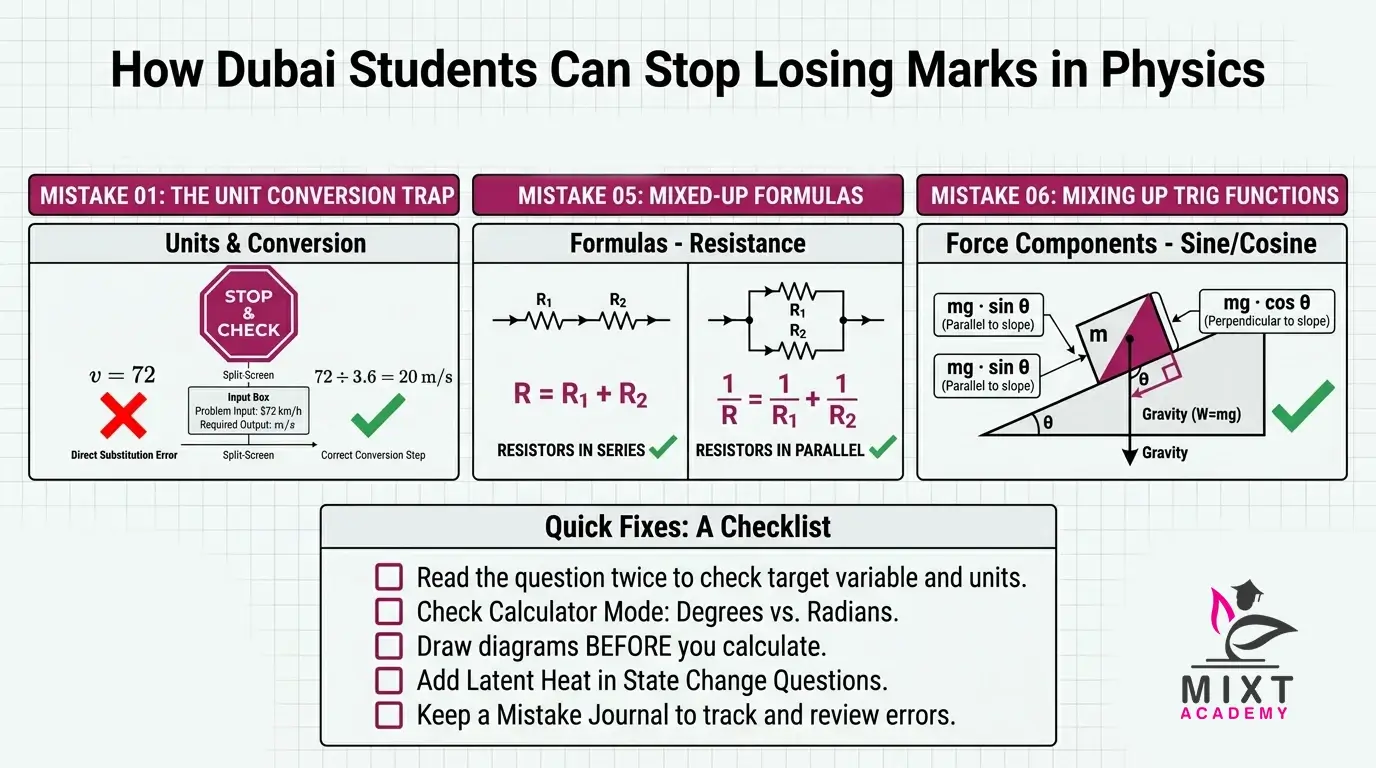
This guide covers the most common physics tutoring in dubai errors committed by students and how to avoid them. Making these simple adjustments can improve your grade more effectively than extra hours of revision alone.
6 Most Common Physics Exam Mistakes Dubai Students Make
Mistake 01 – Answering in the Wrong Unit System
Many students overlook this simple step under the pressure of an exam. A problem provides values in one set of units and requires the solution in another set of units. The student does all the work properly and records the answer without converting the units; they get a zero for that.
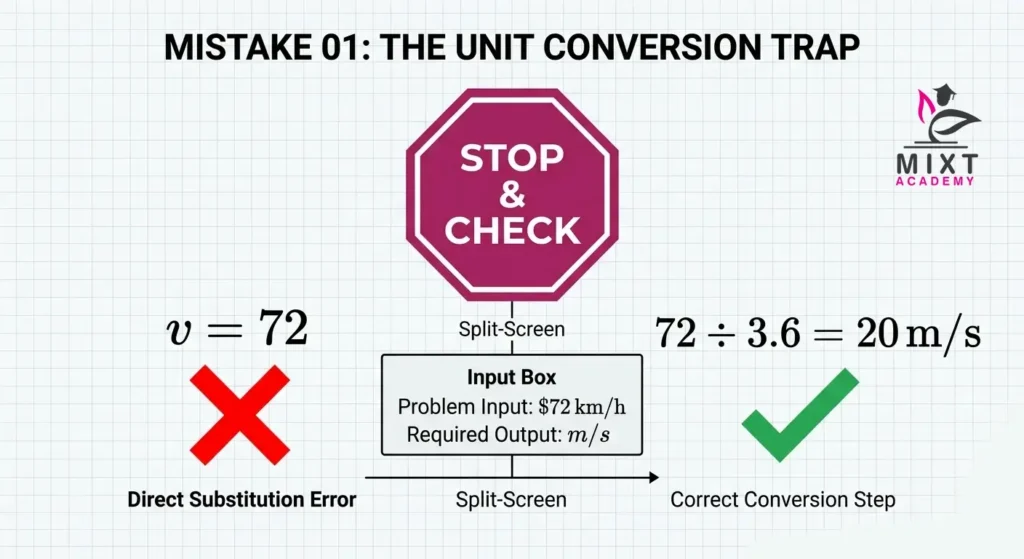
This happens more often than students realise. A problem may provide values in one unit but require the solution in another. Read the question thoroughly before you start writing.
Pay attention to the units of the data and the unit being requested in the question. Convert first, then calculate, if a problem provides speed (km/h) and asks for the answer in the form of v = d/t (metres per second).
Mistake 02 – Mixing Up Units Within One Problem
A close relative of the first error. A student is provided with two values in two different unit systems (e.g., one in CGS, one in MKS) and uses both in the same formula. The calculation is correct, but the answer is not correct because the units were not made consistent.
When substituting numbers, ensure that all of them are measured in the same unit system. It’s one little thing, but it can save you from losing a complete mark on a question that you know how to answer.
Mistake 03 – Confusing Degrees With Radians
Most IGCSE physics problems use degrees, but angular velocity and acceleration are typically measured in radians. Even if your method is correct, failing to check your calculator’s mode will lead to the wrong answer.
When a question refers to the motion of a circle, rotational speed or any other angular term, stop and reflect whether the angle is in degrees or radians. When in the slightest doubt, convert. The formula for the angular speed is the angle in radians divided by the time, ω = θ/t. Missing this detail is an easy way to lose marks unnecessarily.
Quick Tip
As you solve the problem, record the unit next to each value. You will see you have made a mistake before it takes marks off the final answer if the units are different from the ones required in the question.
Mistake 04 – Forgetting Latent Heat in Thermodynamics Questions
Wherever the state of the object is changing, such as ice changing to water or water changing to steam, latent heat must be added to the calculation. Many online tutors in Dubai students do not attempt this question and lose the full marks allocated for this question.
Once you see any reference to melting, freezing, boiling or condensing in a problem, incorporate latent heat into your problem. This can be done with the formula Q = mL, where L is the specific latent heat of the substance. Ensure you don’t leave it out.
Mistake 05 – Getting Series and Parallel Resistance Wrong
One of the most common marks lost in electricity questions is that students understand the difference between a series circuit and a parallel circuit. However, they may use the incorrect formula or get the two formulas mixed up during the test.
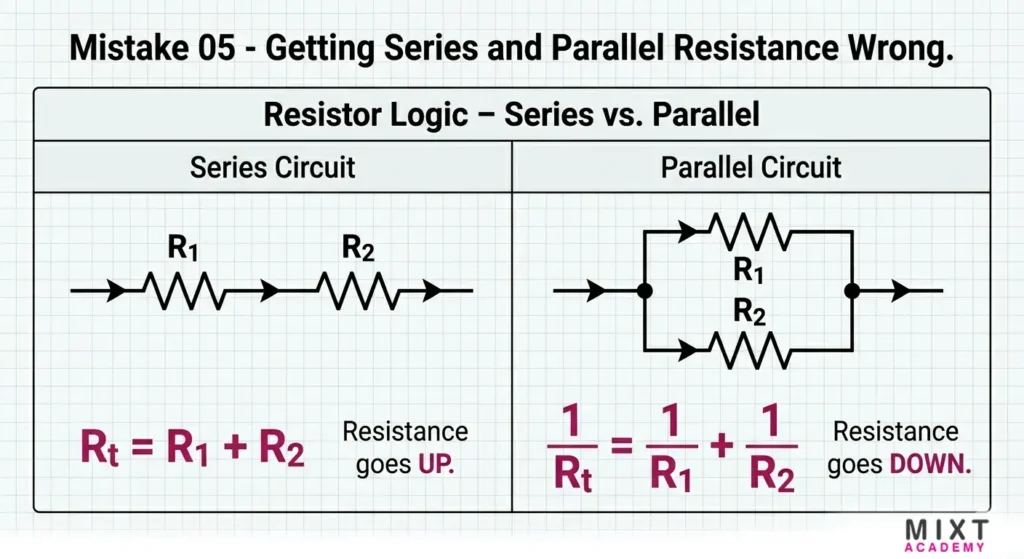
Remember, for resistors in series, total resistance is simply R = R₁ + R₂. For resistors in parallel, you use 1/R = 1/R1 + 1/R2. The parallel formula gives a total resistance that is always smaller than the smallest individual resistor. Use that as a sense check on your answer.
Mistake 06 – Mixing Up Sine and Cosine in Force Problems
Force problems on inclined planes or with angled vectors require breaking forces into components. A huge number of students swap sine and cosine at this step and end up with the wrong component, leading to a completely wrong answer.
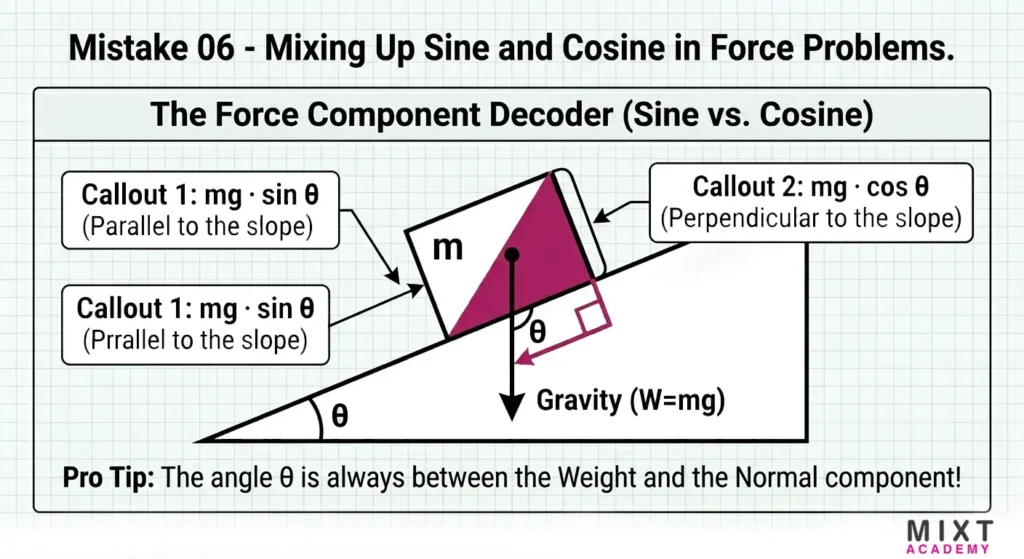
The rule is straightforward. sin θ = opposite / hypotenuse, and cos θ = adjacent / hypotenuse. Draw a right triangle every single time you deal with a vector at an angle. The diagram removes the guesswork and shows you clearly which trig function belongs where.
Study Habits That Help You Stop Repeating Physics Errors
Most physics errors are not random. They follow a pattern, and once you spot yours, fixing it becomes straightforward. Build these habits into your regular study routine.
- Keep a Mistake Journal: After every test or homework session, log each error. Note whether it was a concept gap, a wrong formula, or a simple calculation slip.
- Draw Before You Calculate: Sketch a free-body diagram, circuit layout, or motion path for every problem. Visuals reveal the right approach faster than rereading the question.
- List Knowns and Unknowns First: Write down every given value and the target variable before choosing any formula.
- Check Units at Every Step: If the units do not balance, the formula is being used incorrectly.
- Practice Under a Timer: Exam pressure causes rushed steps. Train under time conditions so it feels familiar.
Important!
Most Dubai students who lose marks in physics exams already know the content. Marks are often lost during the calculation process, even when the student understands the basic GCSE physics tutor. Small fixes to how you approach each problem make a bigger difference than hours of extra revision on theory alone.
Easy Ways to Avoid Physics Mistakes and Improve Exam Grades Fast
Improving your physics grade does not always require more study hours. Most of the time, it requires fixing small habits that are quietly costing you marks on topics like Newton’s Laws, Ohm’s Law, and energy conservation.
- Check Units: Always convert all values into consistent units before using formulas like F = ma or V = IR to avoid calculation errors in physics exams.
- Draw Diagram: Sketch a clear diagram first to correctly identify forces and directions and choose between formulas like F = mg sin θ or cos θ.
- Read Twice: Read each question twice to fully understand the target variable and the required units before you begin.
- Mistake Notebook: Maintain a notebook of errors, like wrong units or formulas, and revise it regularly to avoid repeating the same mistakes.
- Focus Topics: Prioritise high-frequency topics such as Newton’s Laws, energy conservation, and Ohm’s Law for faster improvement in exam performance.
- Check Sense: Always verify if your final answer is realistic compared to known values like 9.8 m/s² or speed-of-light limits.
What to Do in the Final Week Before Your Physics Exam
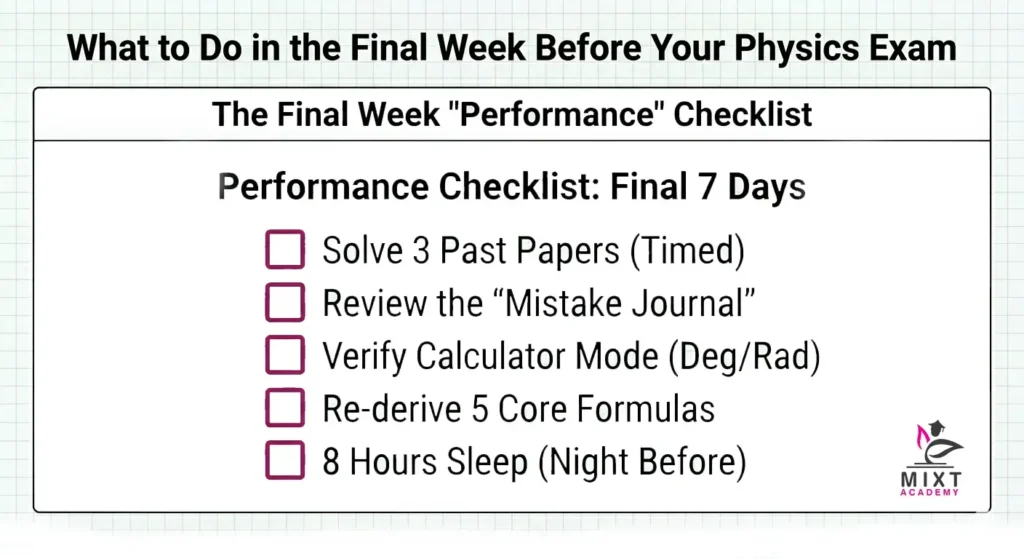
The final week before your A level physics exam should focus on revision, practice, and confidence building. Instead of learning new topics, refine what you already know, correct mistakes, and strengthen your problem-solving speed to perform better in the exam.
Build Your Study Plan
- Solve Papers: Practice past exam papers and focus on questions where you lose marks by solving them fully, not just reading answers.
- Make Sheet: Create a single formula sheet with key equations, constants, and definitions for quick daily revision.
- Fix Errors: Review old tests and homework to find repeated mistakes and spend extra time correcting those weak areas.
- Time Practice: Train yourself to read a question and quickly identify the solving method within two minutes.
Prepare for Exam Day
- Timed Test: Attempt at least one full paper in real exam conditions to build speed and stamina under pressure.
- No New Topics: Avoid learning new chapters in the final days, as it can confuse and reduce confidence.
- Pack Ready: Prepare all exam materials the night before, including a calculator, pens, pencils, and backups.
The Final 24 Hours
- Review Sheet: Quickly go through your Physics formula sheet once to refresh key points without stress.
- Eat Well: Have a light meal and stay hydrated to keep your brain active and focused.
- Sleep Early: Get proper sleep before the exam, as rest improves memory and performance significantly.
Hire the Best Online Tutors for Your Child
Summary
Dubai students commonly lose physics exam marks due to six avoidable mistakes: answering in the wrong unit system, mixing units within one problem, confusing degrees with radians, leaving out latent heat in thermodynamics, applying the wrong resistance formula for series and parallel circuits, and swapping sine with cosine in force problems. Each of these errors happens not because of a lack of knowledge, but because of rushed work or skipped checks. Our IGCSE physics tutors are fix them requires practice under exam conditions, reviewing worked examples, keeping a mistake log, and building habits around unit checking and diagram drawing. The final week before an exam should focus on reinforcing these habits, not learning new content.