
The good news is that neither branch is impossible. The two systems operate through specific reasoning, which becomes accessible when students discover their own learning preferences. The pattern of students who excel in one subject area tends to match their performance in the other, which is typical behaviour.
At Mixt Academy, trusted by UAE and global parents for 10+ years, expert IGCSE tutors have helped hundreds of students improve in chemistry. We help students identify exactly where to focus their efforts and turn chemistry from a stressful subject into one they approach with confidence.
What Is Organic Chemistry in IGCSE?
Organic chemistry is the study of carbon-based compounds. IGCSE Organic Chemistry is made up of carbon compounds such as alkanes, alkenes and alcohols. As well as being made up of crude oil, fuel, homologous series and the process of making polymers.
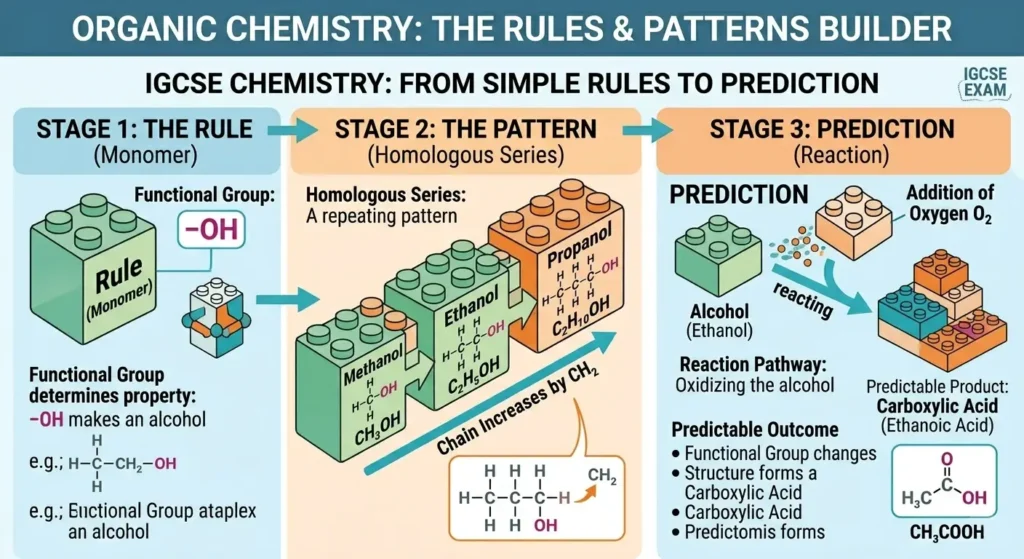
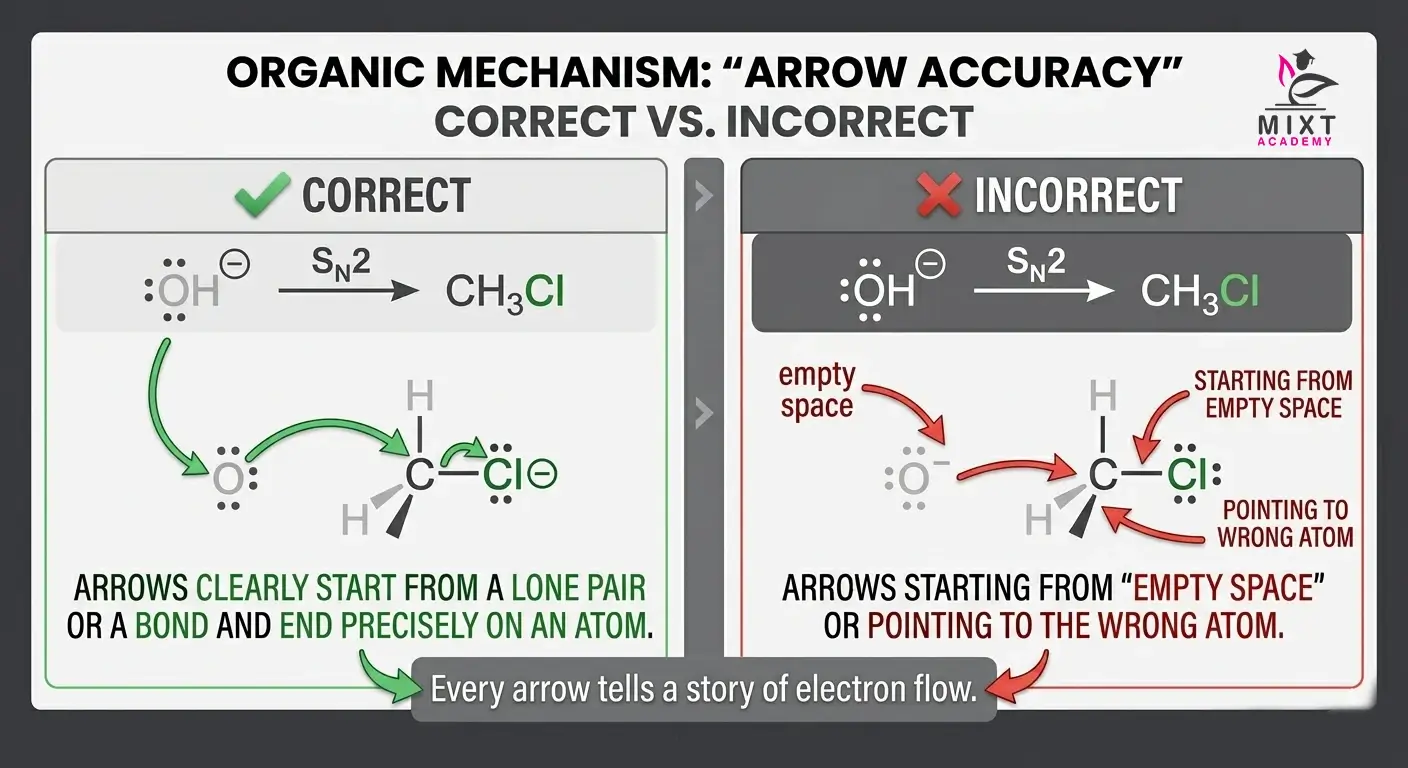
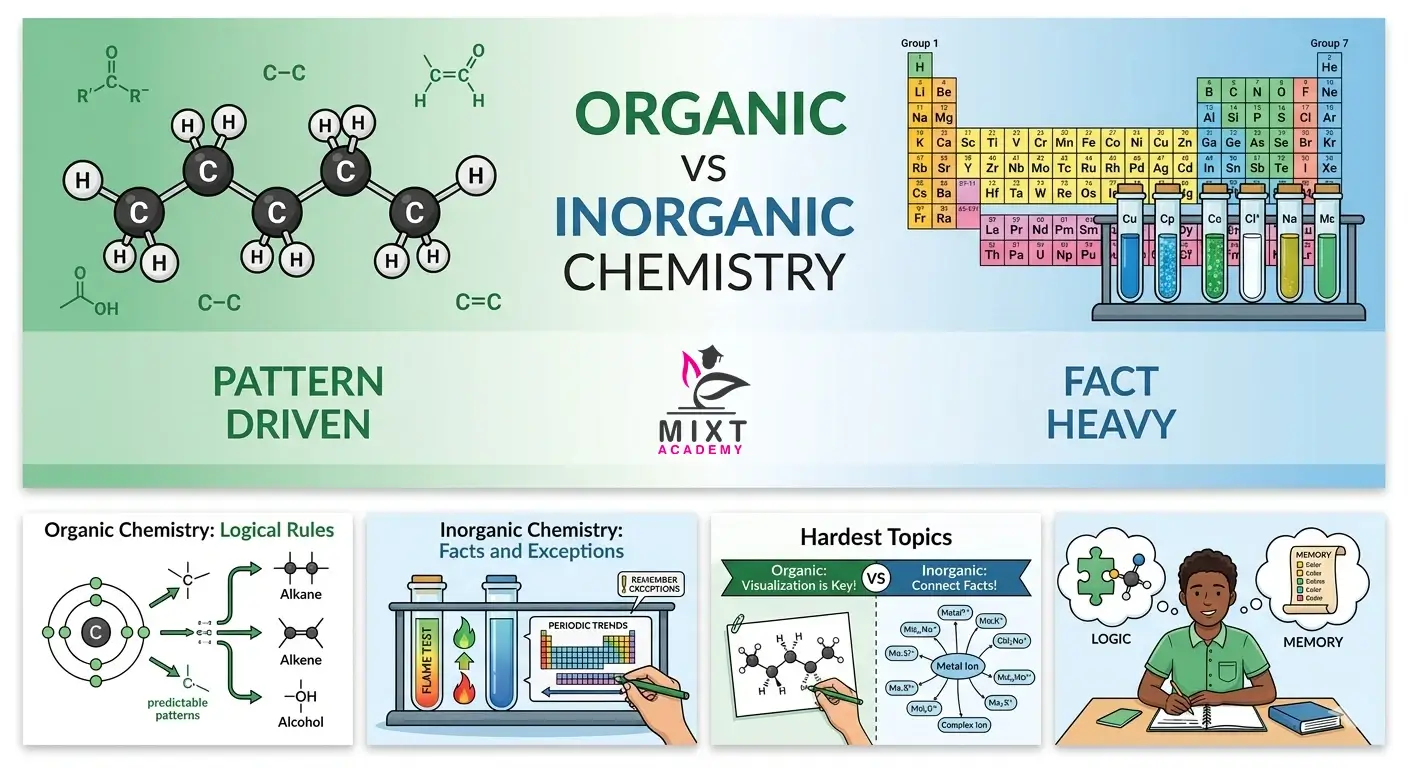
The defining feature of organic chemistry is that it runs on rules and patterns. Once you learn how a functional group behaves, you can predict how it will react in new situations. This makes organic chemistry highly logical and pattern-driven rather than dependent on raw memorisation.
Key Topics in IGCSE Organic Chemistry
- Carbon Compounds: Alkanes, Alkenes, and Alcohols all follow a consistent, predictable naming convention based on the structure and number of carbon atoms in a given compound.
- Homologous Series: A family of compounds that share the same general formula and reactivities, therefore aiding in the prediction of certain physical properties (e.g., the boiling point) across the entire group.
- Functional Groups: Specific arrangements of atoms (e.g., OH, COOH) that determine how that compound will behave in a given reaction.
- Reaction Types: Addition and Substitution reactions have the same rules of conduct for many different Organic compounds.
- Polymerisation: This is the process by which small monomer units join together to form long-chain polymers, and the logic behind it is straightforward once you see it visually.
What Is Inorganic Chemistry in IGCSE?
Inorganic chemistry covers everything that is not carbon-based. This includes the Periodic Table, metals, acids, bases, salts, transition metals, electrolysis, and chemical tests. Many of these topics will already feel familiar because students often touch on them in earlier science classes.
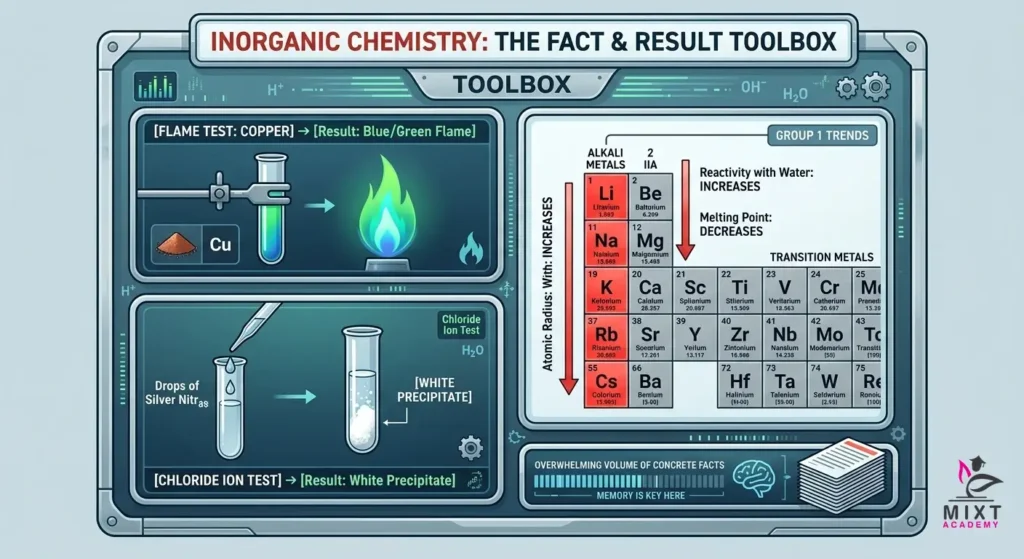
Inorganic chemistry relies more on concrete facts and specific results. For example, knowing that copper produces a blue flame or that chloride ions give a white precipitate in a test. This makes it feel accessible at the start, but the volume of facts can become overwhelming as you go deeper.
Key Topics in IGCSE Inorganic Chemistry
- Periodic Table trends: Group 1 and Group 7 elements follow clear patterns in reactivity, but there are exceptions that need to be memorised carefully.
- Acids, bases, and salts: These are foundational concepts that appear across many exam questions and require both understanding and recall of specific reactions.
- Transition metals: These elements have unique properties like variable oxidation states and the ability to form coloured compounds, which require memorisation of specific facts.
- Chemical tests: Flame test colours, precipitate colours, and gas tests are all specific results that must be recalled accurately during exams.
- Electrolysis: This topic involves understanding what happens at each electrode and requires you to predict products based on the type of electrolyte.
Organic vs Inorganic Chemistry: A Side-by-Side Comparison
| Feature | Organic Chemistry | Inorganic Chemistry |
|---|---|---|
| Main Focus | Carbon compounds like alkanes and alkenes | Metals, Periodic Table, acids, bases, and salts |
| Primary Skill | Logical reasoning and recognising patterns | Memory and memorising facts and trends |
| Key Challenge | Understanding reaction mechanisms and structures | Memorising exceptions and specific facts |
| How It Feels at First | Overwhelming and unfamiliar | Familiar and more concrete |
| Long-Term Experience | Becomes more logical and enjoyable with practice | Can become repetitive and fact-heavy |
| Best For | Students who enjoy problem-solving and patterns | Students who have a strong memory for details |
Which One Is Actually Easier?
The honest answer is that it depends on you as a learner. Neither branch is universally easier. What matters is how you prefer to study and how your brain processes information.
Organic Chemistry Is Easier If You Think Logically
Many students assume organic chemistry will be the harder section because it looks unfamiliar in the beginning. But once the foundational rules click, it becomes much more manageable than expected.
The reason is that organic chemistry operates on a consistent system. You learn the rules for functional groups once, and then you apply them repeatedly. You do not need to memorise every possible outcome because you can reason through it using what you already know.
Students who enjoy solving puzzles, spotting patterns, or working through problems step by step usually find organic chemistry to be their stronger area. Structural isomerism and naming rules can feel tricky at first, but they follow clear logic that rewards practice.
Inorganic Chemistry Is Easier If You Have a Strong Memory
Inorganic chemistry feels more approachable at the beginning because the topics are grounded in real-world examples. You already know what an acid is. You have heard of the Periodic Table. The language feels less foreign.
For students who find it easy to memorise lists of facts, specific colours, and reaction outcomes, inorganic chemistry can feel very manageable. The key is staying disciplined with revision because the volume of content is high, and exceptions to rules can catch you off guard in exams.
Hardest Topics in Each Branch
Every IGCSE chemistry student hits a wall at some point. Here are the topics that tend to cause the most difficulty in each branch.
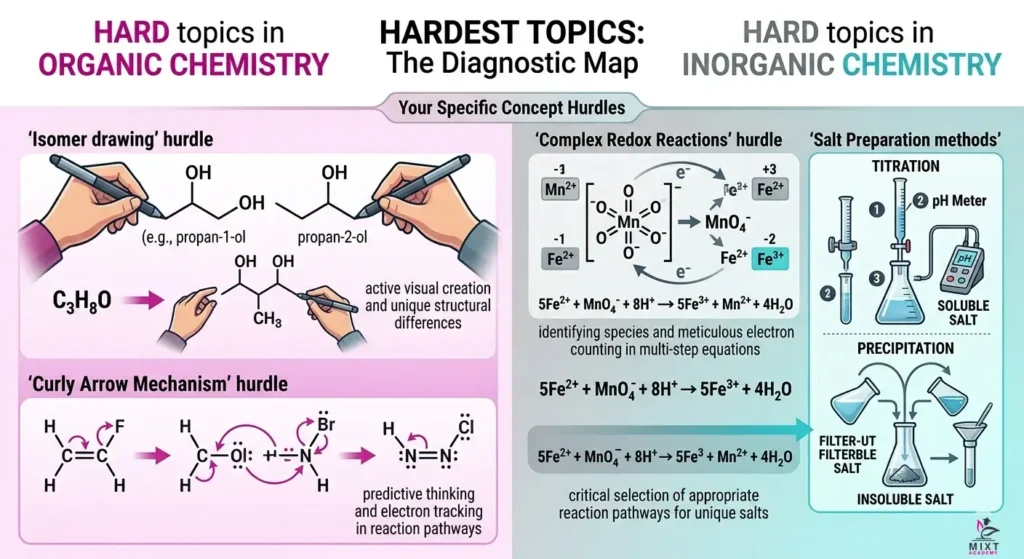
Hardest Organic Chemistry Topics
- Structural isomerism: Drawing all possible structures for a given molecular formula can be confusing without a systematic approach.
- Naming complex compounds: The IUPAC naming system has specific rules, and mistakes in naming are a common source of lost marks.
- Addition and substitution reactions: Understanding why a particular reaction pathway is chosen requires a clear grasp of the underlying mechanism.
Hardest Inorganic Chemistry Topics
- Transition metal properties: Variable oxidation states and coloured compounds require precise factual recall that does not follow simple patterns.
- Redox reactions: Identifying what is oxidised and what is reduced, especially in complex reactions, requires careful and methodical thinking.
- Salt preparation methods: Knowing which method to use for which type of salt is a common area where students lose marks under exam pressure.
How to Study Each Branch Effectively
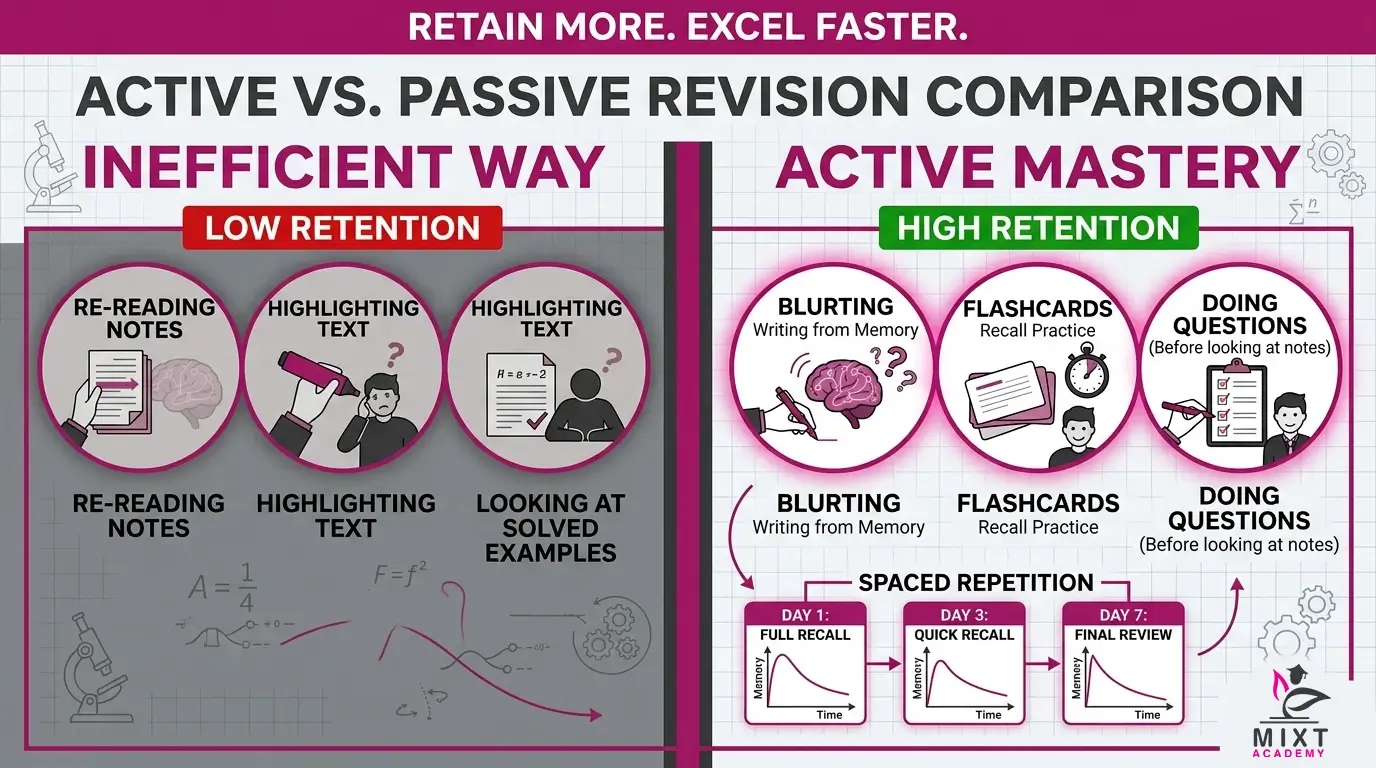
Getting good marks in IGCSE/GCSE chemistry tutors are not just about understanding the content. It is also about how you revise and practice.
Tips for Studying Organic Chemistry
- Use visual diagrams: Drawing out molecular structures by hand helps you understand 3D arrangements and remember the differences between compounds.
- Group reactions together: Study addition reactions as a group, then substitution reactions as a group, so you can see the patterns clearly.
- Make a functional group chart: Create a one-page reference that lists every functional group, its name, and how it typically reacts.
- Practice naming compounds: Spend time specifically on IUPAC naming rules because this skill builds confidence across many organic questions.
- Do not leave it late: Organic chemistry rewards consistent practice over time much more than last-minute cramming.
Tips for Studying Inorganic Chemistry
- Understand the why behind trends: Instead of just memorising that reactivity increases in Group 1, understand why this happens, so the fact sticks better.
- Use colour-coded notes: For topics like flame tests and precipitate colours, visual memory aids are very effective.
- Group exceptions together: Rather than being surprised by exceptions during the exam, create a dedicated list and revise it regularly.
- Focus on chemical test results: These appear very frequently in IGCSE papers and are straightforward marks if you have memorised them correctly.
Revision Strategy Comparison Table
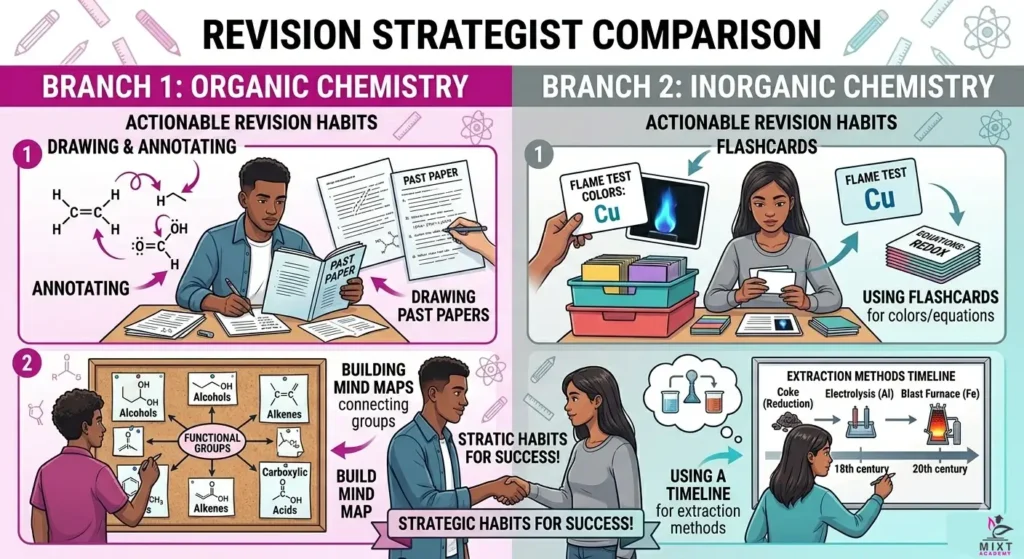
| Revision Activity | Best for Organic | Best for Inorganic |
|---|---|---|
| Flashcards | Functional groups and reaction conditions | Flame test colours, precipitate colours, and gas tests |
| Past Papers | Reaction mechanisms and structural questions | Chemical test questions and periodic trends |
| Mind Maps | Connecting reaction types across the homologous series | Grouping properties of elements in the same group |
| Practice Drawings | Structural formulas and isomers | Electrolysis diagrams and apparatus |
| Timeline Revision | Understanding the order of reaction steps | Memorising extraction methods for metals |
What IGCSE Exam Boards Expect From You
Whether you are sitting the CAIE or Pearson Edexcel, the expectations are broadly similar. You need to be able to recall specific facts, apply them to new contexts, and sometimes evaluate unfamiliar scenarios using your existing knowledge.
For organic chemistry, the exam will often give you a compound you have not seen before and ask you to predict its properties or reactions based on your understanding of functional groups and patterns.
For inorganic chemistry, the exam tends to test specific recall more directly. You may be asked to identify a metal ion from a flame test result or predict the product of a reaction between specific acids and bases.
From Confused to Confident in Chemistry — Start Your Shift Now
Turn confusion between organic and inorganic chemistry into clear exam confidence. Join Mixt Academy for targeted IGCSE tutoring, personalised learning plans, and expert guidance. Book your first session today and discover how to improve your chemistry grades faster than expected.
The most important strategy for both branches is consistent past paper practice. IGCSE chemistry questions are often very similar in style across different years, and students who work through many papers find that the format becomes very familiar very quickly.
Final Thoughts
There is no single answer to which branch of IGCSE chemistry is easier because the answer genuinely depends on you. If you enjoy logical thinking and spotting patterns, organic chemistry will reward you well once you get past the initial unfamiliarity. If you have a reliable memory for facts and concrete details, inorganic chemistry tutors may feel more comfortable throughout your revision.
The most important thing is to start early, practise regularly, and focus on understanding reactions rather than just memorising them. Students who understand the why behind a reaction can answer unfamiliar questions, while students who only memorise the what often struggle when exams present new scenarios.
Both branches are very learnable with the right approach. Identify your strengths, build on them, and use targeted strategies to handle the areas where you find it harder.