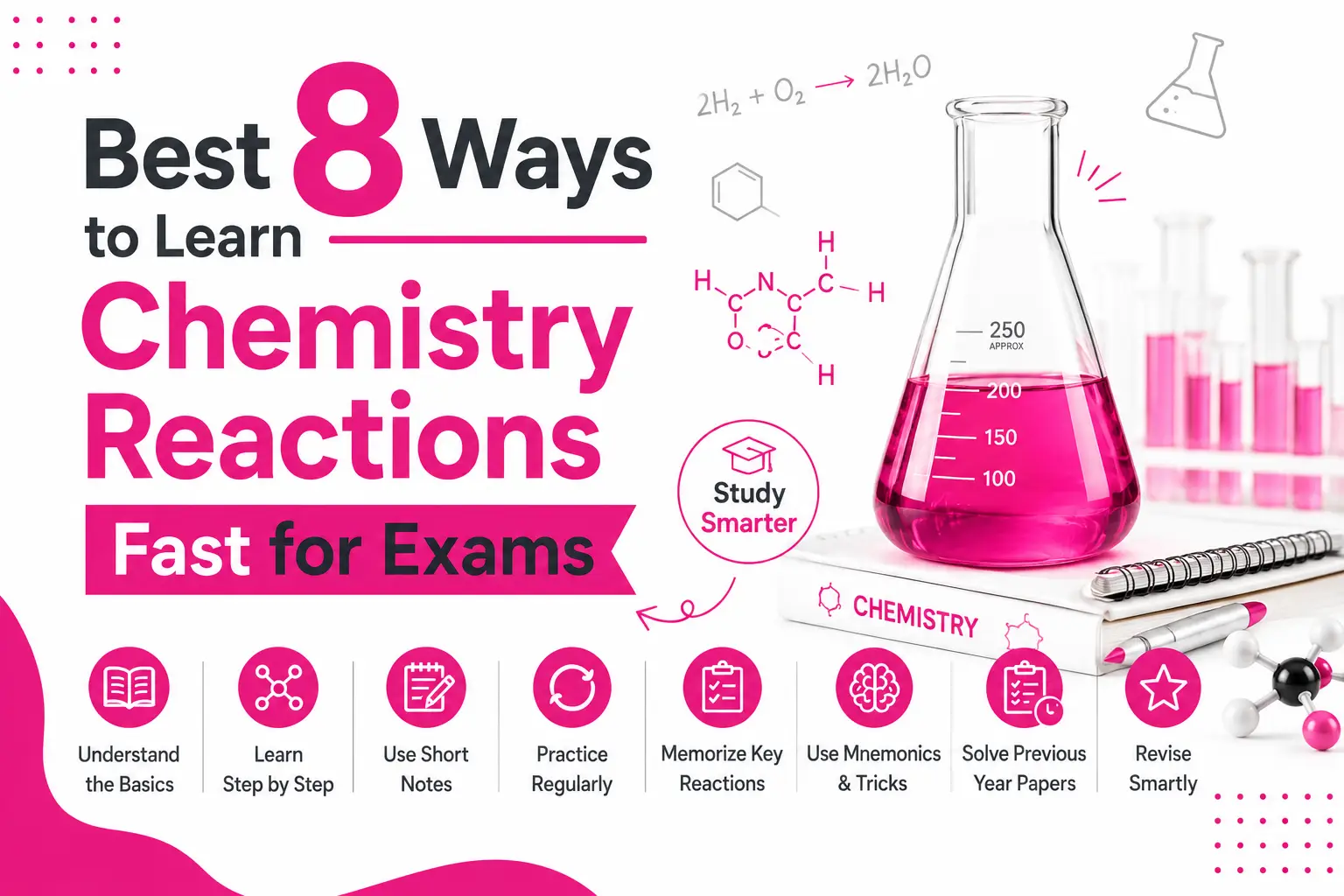
These eight proven strategies will help you learn chemistry reactions faster and more confidently for A Levels, IB, and other curriculum requirements. Mixt Academy offers certified online chemistry tutors in Dubai and worldwide who help students employ these methods to acquire genuine knowledge, preparing them for exams.
8 Effective Ways to Learn Chemistry Reactions Quickly
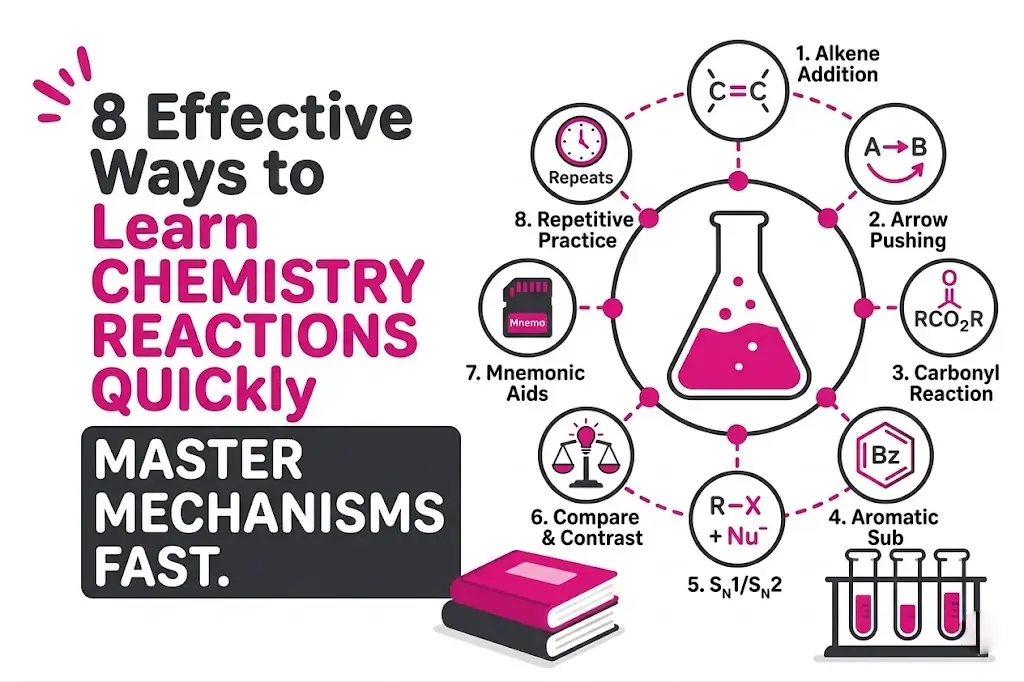
- Draw Reaction Roadmaps
The visual maps show how one functional group transforms into another, eliminating the need to read through extensive lists of information. The progression of an alkane to a halide and then to an alcohol and an aldehyde and finally to a carboxylic acid needs to be mapped out. The roadmaps create better memory retention for pathways because they provide more effective learning methods than conventional linear notes. - Use Active Recall Writing
Take a completely blank sheet of paper and write down every reaction you can remember for a chapter. Once done, check your textbook, correct mistakes in red ink, and repeat the exercise the next day. This method forces your brain to retrieve information actively, which is proven to strengthen long-term memory. - Build Flashcards for Reagents
The flashcard design should present information in the following order:
Reactant → Reagent → Product
You should cover one part of the material to check your knowledge through regular testing. - Group Reactions by Type
The process requires you to divide reactions into multiple categories, which include oxidation, reduction, substitution, elimination, and addition. The study method, which focuses on types instead of chapter content, reveals to you different patterns. The patterns you observe will enable you to determine exam answers for questions that seem unfamiliar to you. - Learn Mechanisms
The complete product of a reaction can be determined through electron movement analysis, which enables you to study its nucleophiles and electrophiles together with their reaction mechanisms. The exam process requires this advanced knowledge because memory will fail to provide the necessary content during testing. - Use Colour-Coded Notes for Inorganic Reactions
Inorganic chemistry requires students to use colour coding for vital information, which includes the identification of precipitate colours and the documentation of gas release. For example, AgCl appears white, whereas AgBr shows a pale yellow tint and AgI displays a yellow colour. The use of different coloured pens for each category enables users to create visual distinctions which become easier to remember during high-stress situations. - Create Mnemonics and Memory Tricks
Create brief phrases which serve as memory aids for common reagents and their respective functions. The strong reducing properties of LiAlH₄ enable it to reduce both acids and esters, while KMnO₄ functions as a powerful oxidising agent. New information becomes easier to remember because mnemonics connect it to existing knowledge. - Revise with Past Papers Daily
Use the final 15 to 20 minutes of each study session to complete past paper questions about chemical reactions. Past papers reveal exactly how questions are framed, which reactions are tested most frequently, and what level of detail is expected. Your exam preparation should include the completion of at least five years of past exam papers before your upcoming exam.
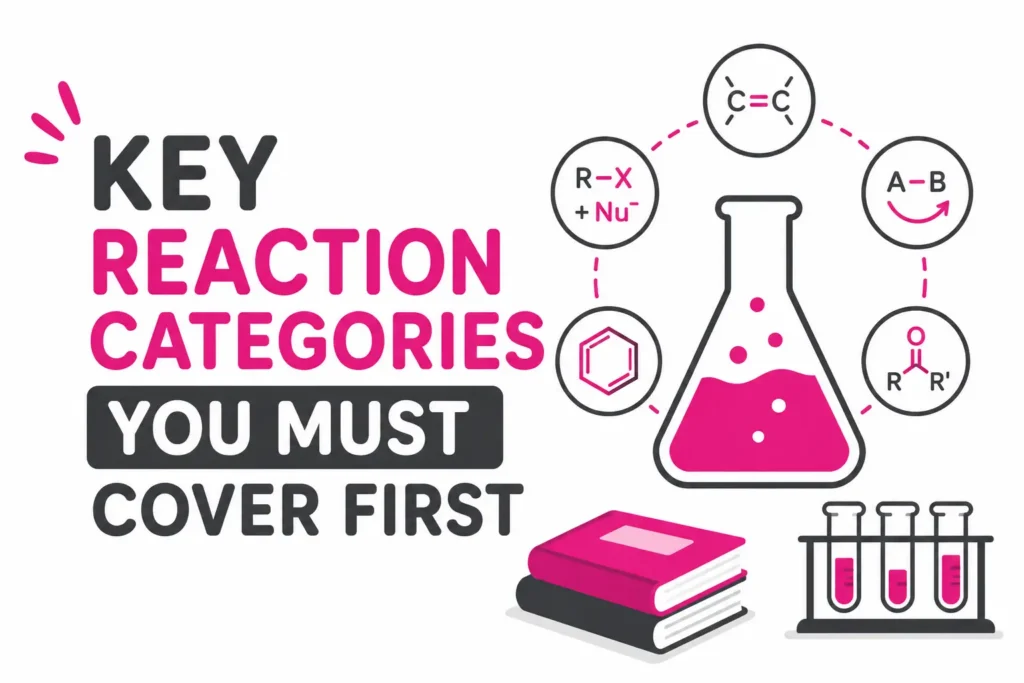
Key Reaction Categories You Must Cover First
Before diving into all chapters equally, prioritise the reaction types that appear most often in exams. For IGCSE organic chemistry tutoring, ensure you are confident with name reactions, haloalkanes, alcohols, aldehydes, ketones, carboxylic acids, and amines.
For inorganic chemistry, focus on periodic trends, redox reactions in p-block elements, and key industrial processes like the Haber (or Haber-Bosch) process and the Contact process.
In physical chemistry, make sure you understand rate laws, the Arrhenius Equation, and stoichiometry-based balancing. Prioritising these categories ensures that even limited study time gives you maximum exam coverage.
Common Mistakes Students Make When Studying Chemistry Reactions
Many students struggle with chemistry reactions because they focus too much on memorisation instead of understanding the science behind the process. Errors in balancing equations, identifying compounds, interpreting calculations, and reading exam questions carefully can all lead to lower marks and confusion. Understanding these common mistakes can help students improve both their problem-solving skills and overall confidence in A level chemistry tutoring.
1. Poor Study Habits & Conceptual Mistakes
Memorising Without Understanding
Students who try to memorise chemical reactions and their corresponding formulas and definitions without first understanding the fundamentals of chemical reactions create their most significant academic errors. Students find GCSE chemistry tutor, easier to learn when they know how electrons move between atoms and how ionic bonds form and break.
Confusing Organic Functional Groups
Students frequently confuse essential organic chemistry functional groups that include alcohols, aldehydes, ketones and carboxylic acids. This confusion leads to choosing incorrect reaction pathways, which results in incorrect product predictions.
Ignoring Reaction Mechanisms
Students treat chemical reactions as simple processes which require only one step to complete, but they need to learn how to work through the entire reaction mechanism. Students need to understand electron movement in order to answer complex reaction problems which involve multiple reaction steps.
2. Errors in Chemical Equations
Writing Unbalanced Equations
The common problem of writing unbalanced chemical equations occurs because people fail to balance chemical equations correctly. The use of incorrect stoichiometric coefficients results in wrong mole ratios, which produce inaccurate mass calculations and final answers that are not correct.
Forgetting State Symbols
Students frequently ignore state symbols such as (s), (l), (g), and (aq). The physical state of substances is shown through these symbols, which also help to identify the conditions of chemical reactions and precipitation reactions.
Incorrect Chemical Formulas
Students create chemical formula mistakes because they lack proper knowledge about valency, ionic charges, and subscripts and superscripts. A tiny mistake in a chemical formula can create a complete transformation in how a chemical reaction proceeds.
3. Calculation & Numerical Mistakes
Ignoring Units
Many students forget to include units or fail to convert them correctly during calculations. Errors involving grams, moles, concentration, or volume units can easily lead to incorrect answers.
Significant Figure Errors
Rounding numbers too early or using inconsistent significant figures can reduce accuracy in chemistry calculations and cost marks in exams.
Not Showing Full Working
Providing only the final answer without showing calculation steps is another common mistake. Showing full working helps teachers follow the method and can earn partial marks even if the final answer is incorrect.
4. Exam & Application Mistakes
Misreading the Question
Students often rush through questions and overlook important keywords such as “excess,” “limiting reactant,” “catalyst,” or “dilute.” Missing these details can completely change the required answer.
Not Understanding Periodic Trends
Many learners try to memorise periodic table trends without understanding the scientific reasons behind them. Concepts such as nuclear charge, shielding effect, atomic radius, and reactivity become easier to remember when students understand the underlying patterns.
Hire the Best Online Tutors for Your Child
Wrapping Up
Chemistry reactions can seem difficult at first, especially when students rely only on memorisation. However, learning becomes much easier when you use active study methods that help you understand how and why reactions occur instead of simply remembering formulas.

Techniques such as reaction maps, flashcards, mechanism-based learning, and regular past paper practice can improve both understanding and long-term retention. Studying reactions by category and focusing on commonly tested reaction types also helps students revise more efficiently.
Consistent daily revision is far more effective than last-minute cramming before exams. With the right study approach, chemistry reactions can become easier to understand, quicker to recall, and much less stressful during exams.