The pressure is real. If you are looking to get a place at one of the great universities in the UAE, a good Chemistry grade is very important. This blog addresses the real reasons why Dubai students fail Chemistry and provides clear, honest solutions that work.
7 Common Reasons Why Dubai Students Fail in Chemistry & How to Fix Them
1. Coming From Different School Systems With Gaps in the Basics
Dubai is home to students from Asian, European, Filipino, Arabic and other regional schooling backgrounds. All the systems have their own way of teaching science. Some students do not have a firm understanding of moles, atomic structure or chemical bonding at GCSE or equivalent.
Fix: The solution is to rebuild your foundation before moving forward. Go back to core topics like moles, atomic structure, and chemical bonding, and make sure you truly understand them rather than just recognising them.
2. Treating Chemistry Like a Memory Subject
Chemistry is not a memory test. Many students, particularly those who have previously been taught by rote, attempt to remember all of the material without developing any real understanding. The same applies to short quizzes, but is totally ineffective when exam questions give an unfamiliar situation or a spin on an idea.
Fix: When studying a topic, try to ask the question “Why does this happen?” rather than “What happens?” Work on applying concepts to test questions that are not similar to what you have worked with in the past. This shift in thinking is what separates average students from high scorers.
3. Weak Maths Skills Slowing Everything Down
Chemistry involves more maths than most students expect. pH calculations require logarithms. Thermodynamics needs algebra. Equilibrium constants involve multi-step arithmetic. If your maths foundation is shaky, you will lose marks, not because you do not understand the chemistry, but because the numbers trip you up.
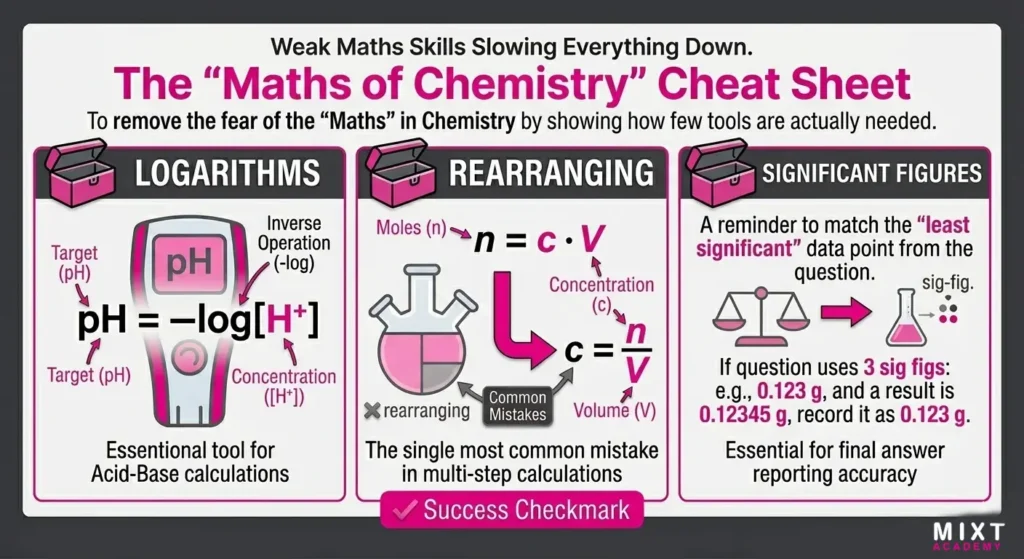
Fix: Spend 15 to 20 minutes a week on the specific maths skills. Chemistry demands:
- Logarithms (for pH and Ka)
- Rearranging equations and algebraic substitution
- Standard form and significant figures
- Percentage error and uncertainty calculations
4. Skipping Past Papers Until It Is Too Late
Many Dubai students spend most of their revision time reading notes and theory, leaving past papers for the final two weeks before exams. By then, there is not enough time to understand what the examiner actually wants, and exam technique takes time to build.
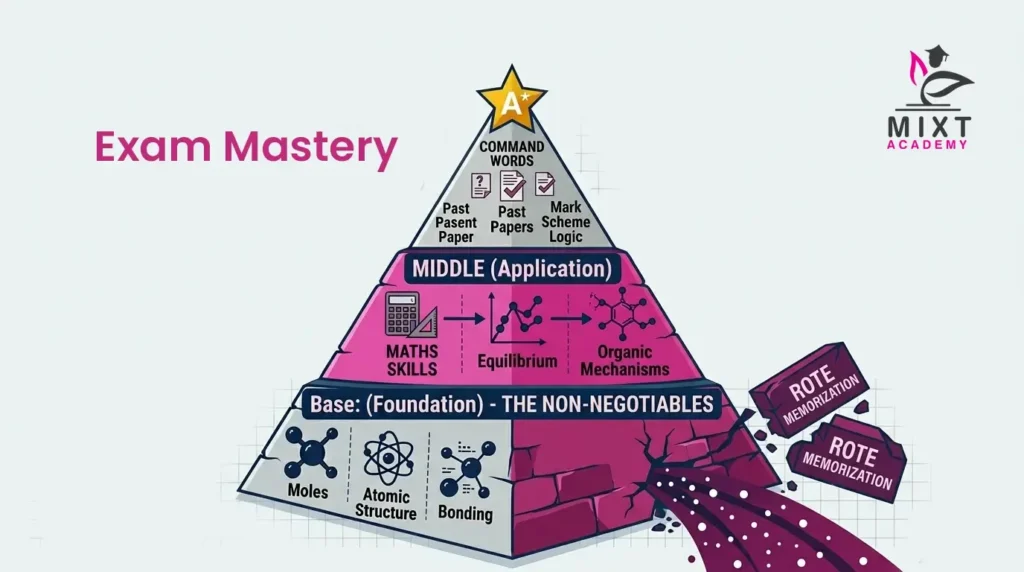
Fix: Start doing past paper questions from the very beginning of each topic, not at the end. Even one or two questions per topic per week builds familiarity with question styles. Always check the mark scheme afterwards, not to copy answers, but to understand what language and structure earns marks.
5. Not Understanding What Examiners Actually Want
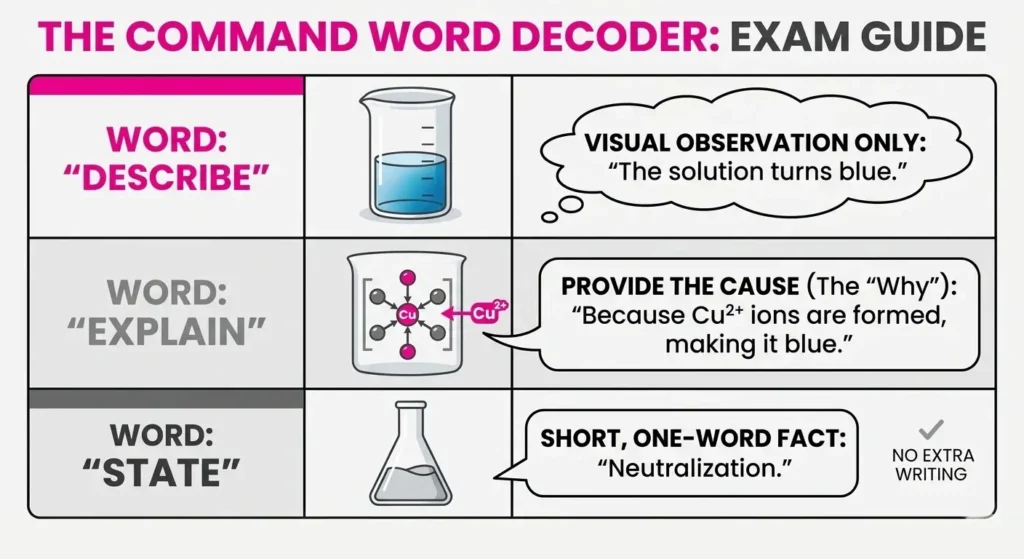
This is one of the most overlooked problems. Students write answers that are scientifically correct but still lose marks because they did not use the right terminology or missed a key command word. “Describe” and “explain” require completely different types of answers. “State” does not need justification. Missing these nuances costs marks across every paper.
Fix: Study command words used by your exam board (AQA, Pearson Edexcel, OCR, or Cambridge). Know exactly what each one is asking. When practising, read the question twice, once for content and once for what type of response is needed.
6. Falling Behind and Never Catching Up
Chemistry is one of the most content-heavy subjects. The problem in Dubai is that school schedules are packed, there are multiple subjects to manage, and private tuition for other subjects often takes priority. One missed chapter becomes two, and by the time mocks arrive, there are huge gaps in the syllabus.
Fix: Use a weekly revision planner. Dedicate at least three focused study sessions per week to fail Chemistry alone. If you fall behind, do not try to catch up all at once; pick the highest-mark topics first and work outwards from there.
7. Disconnecting Theory From Practical Work
Practical questions appear in every Chemistry paper. Students are expected to design experiments, identify variables, evaluate results, and suggest improvements. Many Dubai students treat lab sessions as passive; they watch and write down results without truly engaging. When practical-style questions appear in exams, they have no mental model to draw from.
Fix: During every practical session, ask three questions: What am I testing? Why am I using this method? What could go wrong, and how would I fix it? These three questions alone will prepare you for almost any practical-based exam question.
Chemistry Topics: Difficulty vs. Marks Breakdown
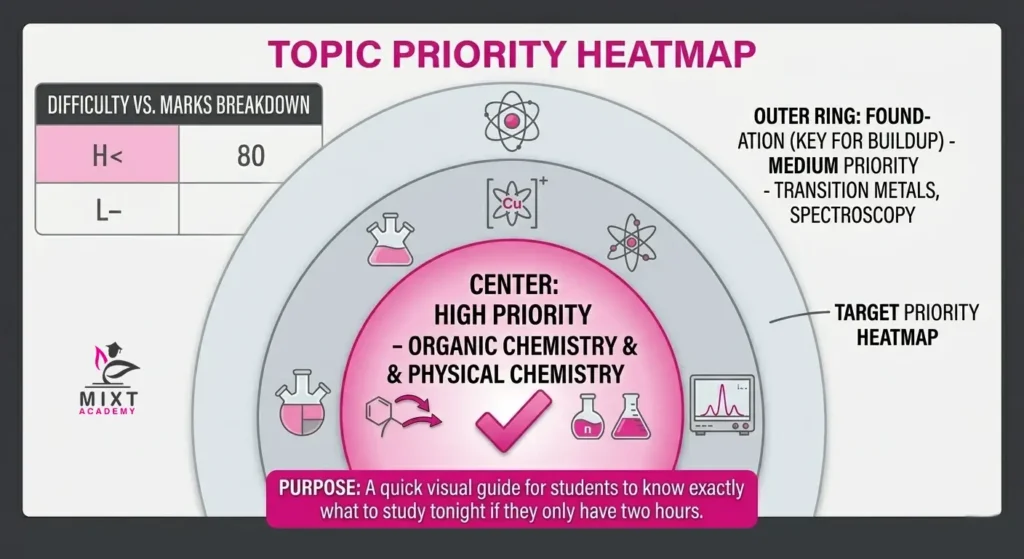
This table shows which topics are commonly considered difficult by students and how much weight they carry in most exam boards. Use it to prioritise your revision time smartly.
| Topic | Difficulty Level | Mark’s Contribution | Priority |
|---|---|---|---|
| Organic Chemistry | High | Very High | Revise First |
| Physical Chemistry (Thermodynamics, Kinetics) | High | High | Revise First |
| Equilibria and Acids/Bases | Medium-High | High | Revise Early |
| Atomic Structure and Bonding | Medium | Medium | Build Foundation |
| Transition Metals | Medium | Medium | Mid-Priority |
| Analytical Techniques (Spectroscopy) | Medium | Medium | Mid-Priority |
| Electrochemistry | High | Medium | Do Not Skip |
| Practical Skills and Data Handling | Medium | Present in Every Paper | Consistent Practice |
The Study Habits That Actually Work for Chemistry
Passive reading does not work for Chemistry. These are the methods that do:
Active Recall
Close your notes and try to write down everything you remember about a topic. Then open your notes to check. This forces your brain to actually retrieve information rather than just recognise it.
Spaced Repetition
Review a topic once the same week you learned it, then again after five days, then after two weeks. This pattern locks information into long-term memory far more effectively than cramming.
Timed Practice
Do not just attempt past paper questions; time yourself. Chemistry tutors in dubai are strict on time. Building speed now removes panic later.
Error Log
Keep a notebook of every question you got wrong. Before any major exam, review that notebook first. Your mistakes are your fastest route to improvement.
How Dubai’s Environment Affects Chemistry Performance
Dubai students face some specific challenges that students in other countries do not always deal with:
Language of Instruction
For many students, English is a second or third language. Chemical terminology in English, words like ‘stoichiometry’, ‘enthalpy’, or ‘electrophilic’, adds an extra layer of difficulty. Building a IGCSE Chemistry tutoring specific vocabulary list in English helps close this gap faster than general English improvement.
Multiple School Systems Under One Roof
In Dubai schools, you will often have classmates from 15 or 20 different countries. Teachers sometimes move at a pace that assumes a background you may not have. Identifying and filling your personal knowledge gaps early is essential.
Private Tuition Culture
Dubai has a strong culture of extra tuition, which is helpful, but only when the tutor is aligned with your specific exam board. Our tutor teaching CIE content to a Pearson Edexcel student can cause more confusion than clarity. Always confirm your tutor knows your syllabus.
Exam Season Pressure
With university applications to top UK, US, and UAE institutions all happening around the same time, the stress in Dubai can peak at the worst possible moment. Building consistent habits across the full year reduces this pressure significantly.
Common Chemistry Mistakes and How to Avoid Them
These are specific errors that come up repeatedly in student exams and cost easy marks:
- Not Including Units in Answers: An answer of “250” instead of “250 kJ/mol” is often marked wrong even if the number is correct.
- Using Casual Language in Explaining Questions: Saying “the atoms join together” instead of “a covalent bond forms when electrons are shared between two atoms” will not earn marks. Precision matters.
- Forgetting Equilibrium Shifts: When asked about Le Chatelier’s principle, students often state the direction of shift but forget to explain why in terms of the system opposing the change.
- Mixing Up Endothermic and Exothermic in Enthalpy Diagrams: A negative delta H means exothermic; energy is released. Many students confuse the sign conventions under exam pressure.
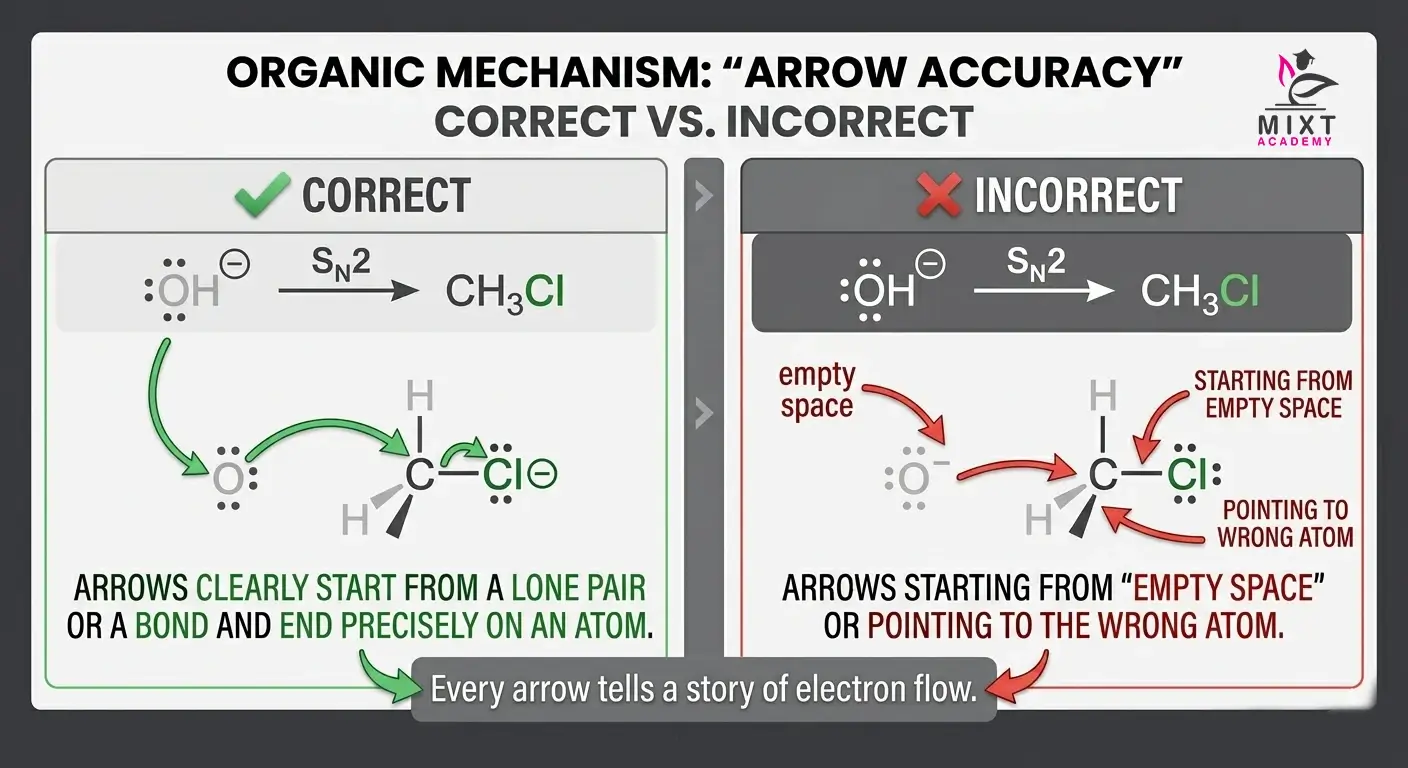
- Incomplete Organic Mechanisms: Every arrow in a curly arrow mechanism must start from a bond or lone pair and end at an atom or bond. Missing one arrow loses the entire mechanism mark.
Hire the Best Online Tutors for Your Child
Wrapping Up
Chemistry is hard, but failing it is always avoidable. For Dubai students specifically, the challenge is rarely about intelligence. It is about entering a demanding course with gaps from a different dubai schooling system, relying on memory instead of understanding, leaving past papers too late, and not knowing what the examiner is actually rewarding. Mixt Academy provide online A level chemistry tutoring practical revision notes and expert exam guideline.
The students who succeed are not necessarily the most naturally gifted. They are the ones who start early, practise consistently, build their mathematical confidence, engage with practical work, and learn how to read exam questions correctly. Change how you study and stay on top of the content week by week, and the grade you want is genuinely within reach, regardless of where you started.